Continuing with the history of the Pennsylvania Avenue trolley bridge, and quoting from the North Wales Record of October 4, 1902 we find the following:
“Just as the last immense girder was about to be placed on its foundation at the Lehigh Valley Traction Company’s bridge across the North Penn tracks at North Wales last Saturday afternoon, it fell with a crash to the railroad tracks below. Walter A. Shearer of North Wales; Eugene Reese of Bethlehem; William J. Barnett of Owego, N. Y., and George Stevits were hurt. Mr. Stevits was taken to the Jefferson Hospital with a crushed foot. Mr. Shearer sustained severe bruises about the head and body.”
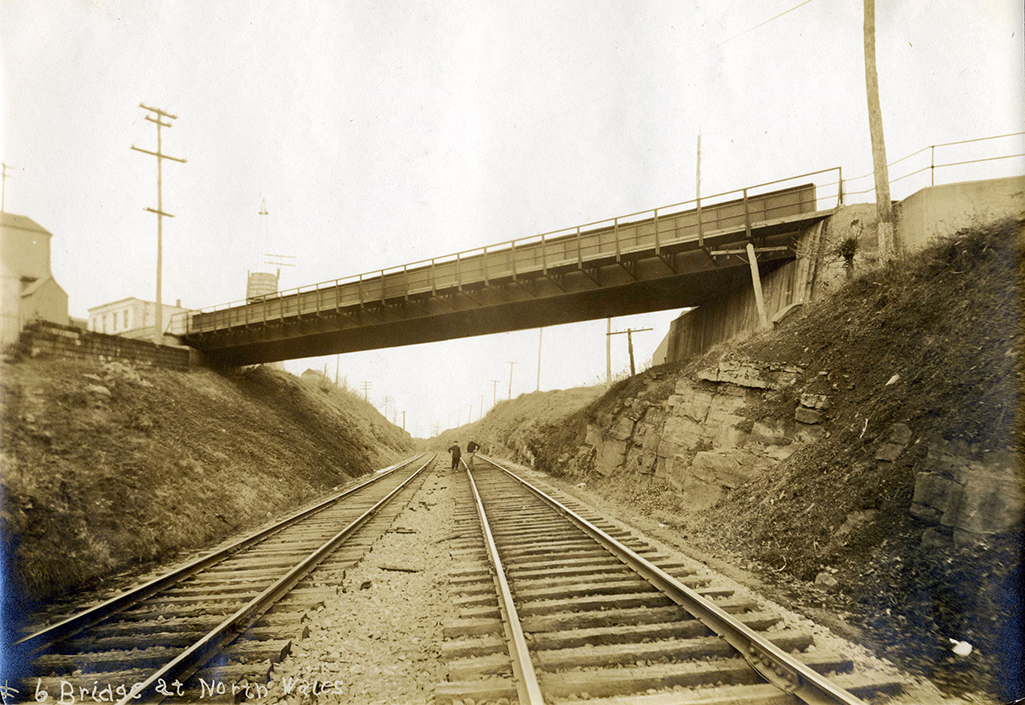
Mr. Barnett, who is superintendent of construction of the Owego Company, which is putting up the bridge, jumped and narrowly escaped with his life. “The two immense girders arrived at North Wales a couple of weeks ago, and the construction company had succeeded in placing them in position at the crossing. when one of them suddenly toppled over and fell to the roadbed of the railroad, some thirty or forty feet below. The girders are each 118 feet long and weigh about 24 tons each. A temporary wooden structure had been erected on either side of the railroad to support the weight of the girders. One girder had been gotten across safely, and the other was nearly over, when it suddenly toppled over and fell. The trains of the North Penn Railroad were blocked at that point for some time, when the railroad wrecking crew succeeded in removing the girder to a position parallel with the railroad tracks, thus permitting trains to pass.
“Had it not been for this mishap the trolley tracks would have been connected at that point within a few clays, thus closing the last gap between Allentown and Flourtown. It will require some time to replace the girders. It was the first accident of its kind that ever happened under Mr. Barnett. He seemed so careful all along with the work of erecting the girders, that much sympathy is expressed for him.”
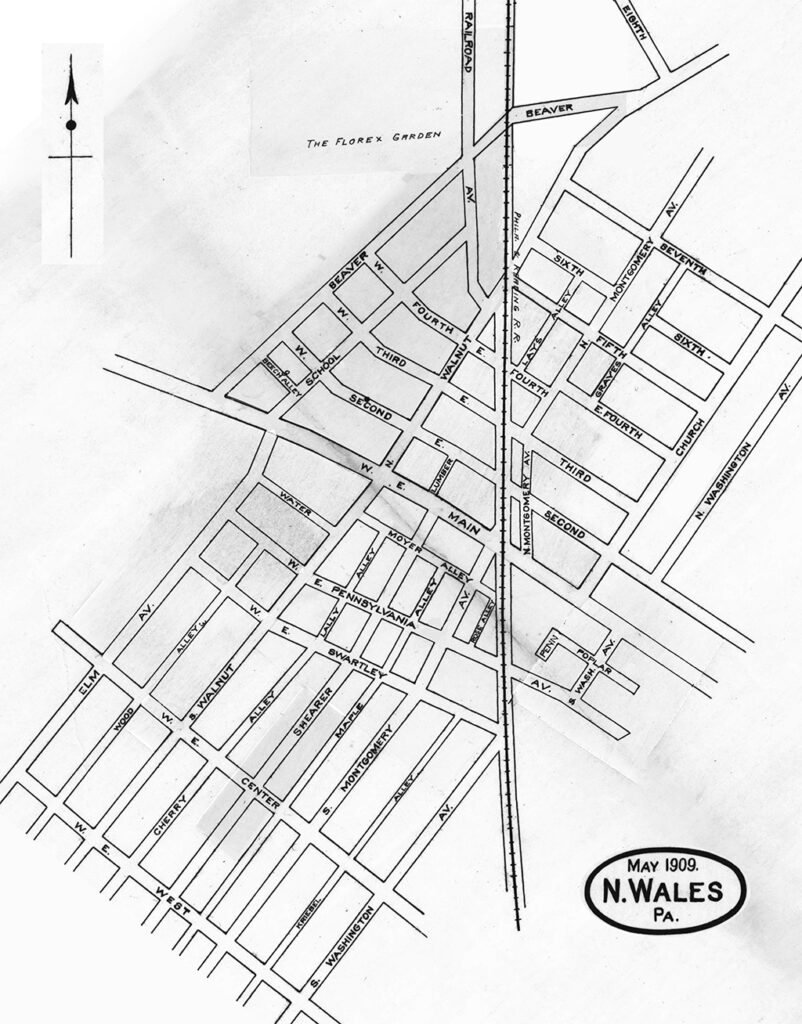
On July 2, 1894 Borough Council passed an ordinance for the numbering of dwelling houses and other buildings within the borough. On September 3, on motion of Thomas P. Scott, Main street and all streets running parallel to it are to be called north and south streets and all streets crossing, or intersecting the same at right angles are to be called east and west streets from Main. The street address numbers are to be known accordingly. John A. Gerhart, our local sign painter, was given the contract for painting the house numbers at seventy-five cents per house.
On May 1900, council granted the request for the erection of a sausage factory at 4th and Church streets. This factory was constructed and did a thriving business. About this time the town was expanding in industry and council felt the need for a fulltime policeman. Accordingly on September 7, 1903 John Stevens was appointed as a fulltime guardian of the law at a salary of $18 per month, to be on duty from six o’clock in the evening until four o’clock in the morning.
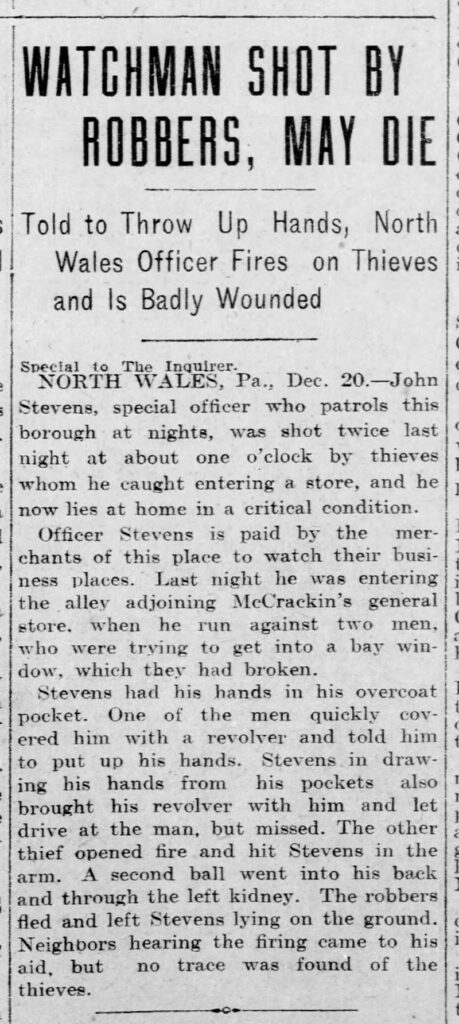
Evidently the appointment of a full time policeman had not been too soon for on December 20, 1904, a special meeting of the council was called for “the purpose of devising ways and means to apprehend the burglars who attempted to rob the store of William F. McCracken on December 19, 1904, and who shot and wounded John Stevens, the policeman.” Council offered a reward of $300 for the arrest and conviction of the robbers. A thorough search of available records discloses that the perpetrators of this crime were never apprehended.
In November of 1905, after serious complaints by Gordon Brothers about sewage being deposited in the creek that runs through their property, and threats of legal action against the borough to remedy the same, Councilman E. K. Freed introduced an ordinance asking that he be given the right to establish a sewer filtration plant. The matter was held under advisement and all property owners having cesspools or drains running upon the Gordon property were notified to have the same disconnected within twenty days. [The Gordon property is today Parkside Place. The houses referred to are the twin houses along the northwest side of Elm Avenue.]
In December of 1905 council appointed a committee of three to secure an engineer and ordered a survey and plans prepared for a sewage plant, the cost not to exceed $500. In May of 1906 plans for a sanitary sewer system were presented and approved, and in November of 1906 E. K. Freed offered to sell to the borough a piece of ground for a sewer disposal plant for the sum of $3,500. On January 7, 1907 the ordinance for the construction of sanitary sewers in the borough was passed. However, the sewers did not become a reality until 1914 when construction was finally begun.
The text of this post is sourced from a column entitled Early North Wales: Its History and Its People penned by long-time North Wales resident historian Leon T. Lewis. The article appeared in its original form in the November 24, 1959 issue of the North Penn Reporter