History snippets

In remembrance: Wilmer H. Johnson, Editor of the North Wales Record from 1877 to 1905

Editorial By Charles M. Meredith, June 5, 1912

Editor and Proprietor of The Central News, Perkasie, Penna.

BY the death of Wilmer H. Johnson a conspicuous manmark is removed from our horizon.

With his sacred relation as husband and parent it is neither our duty nor privilege to engage, save that he was known as a “good provider.”

But with the personal relation of former friend, mentor and employer we propose for a few moments to emblazon the records. For let it be known that Wilmer H. Johnson, formerly editor of the North Wales Record, was the first man by whom we were regularly employed. Of course we remember picking strawberries for Nelson Snedeker for two cents per box; whitewashing for Asa Thomas at five cents per panel, and dropping corn for “Sam” Gordon at fifty cents per day [the farm that is today Parkside Place]. But our first salary was paid by Wilmer H. Johnson, and amounted to $2 per week.

Mr. Johnson was editor of the North Wales Record newspaper beginning in 1877, until 1905.

We stayed six years during which time the salary was increased. We didn’t have to work for Wilmer Johnson. There were other opportunities beckoning, notably the sash factory, where the salary would have been $4, and the suspender factory where the salary for winding bobbins started at $4.50.  But at that particular time the sash factory had earned the epithet of being a man-mangler, and the suspender factory was not certain whether it would stay in the town.  So when Mr. Johnson waved his magic wand, and depicted the fame and emoluments of journalism, our surrender was unconditional—and we lived ever after happy. Beginning in knee pants, and starting our erudition on a soapbox.

It would be extravagant and unnecessary to say that we loved Mr. Johnson. We admired and honored him. This sentiment may be better appreciated when one thinks that McKinley was loved. So was Lee. [Theodore] Roosevelt is admired and respected. So was Grant. Then there was the disparagement in age and temperament between Johnson and the writer. As a matter of fact there was a time in our career when we feared him. For discipline and literary ability were his strangleholds. If Mr. Johnson made one mistake it was locating in what was then a small town, when a city daily at a handsome salary would have been glad to continue his services. His personality, in an executive capacity, could have earned him something splendid weekly if exerted on a force of one or two hundred men, instead of the three or four in the office at North Wales.

His influence was not exerted by gumshoes, nor gliding suddenly around corners, nor catching someone at a prank or lazy attitude. Nor was it accomplished by abuse or harangue. There was merely “something” which neither the youngest nor the oldest employ could dissect, but all stood for! “THE BOSS IS AROUND.” That is all. It was everyone’s intention to please him. The esprit de corps was fine. There was a loyalty and willingness that larger concerns would give thousands to establish. It was not his custom to reward or to punish. Best service he took for granted. Dereliction he seemed to overlook. There were no Christmas presents. But no one was “docked” for a day off now and then, either.

We do not recall that he had any questionable habits. He surely was not given to liquor, tobacco, games of chance—in short did not engage in any of the vices and superfluities of life. And while firmly established in religion, his name was not recorded on any of the local church records.

In the printing department nothing would “do” for a shift. It had to be plumb right. And therefore the North Wales Record was the standard for quality of paper, presswork, and “making the mails.” For a generation he was a foe to the ready-print and the plate service—but yielded toward the end. While cheaper labor could have been employed, he insisted upon making up every form of his four page weekly himself—always. And he started at $1.50 per year—and kept it there—even when Singerly reduced the Philadelphia Record to a cent, and all the other country weekly editors—even yet—give their best for a dollar a year. So that the North Wales Record with 1,500 circulation took in as many and a great deal more profitable dollars than the scrumptious dollar weekly with its far-heralded circulation of 2,000. Same as now.

As a writer Johnson shone. He could as neatly embroider a wedding, high school commencement, or Brunner’s Academy commencement as any man we have ever known. And he could vitriolize an event, or person, or issue that did not meet with his approval as scathingly—and at the same time popularize his own view—as any man we have ever known. For a battle according to “old school” ethics he was the most keenly eager editor we ever knew.

He pecuniarly backed his views, too. We have always had a suspicion that it took some borrowed money to conduct the Record’s campaign against Wanger for Congress, and that it took considerable more exchequer than the income of the paper to pay the special writer employed on the Record that summer and fall. And there was extreme joy—unholy or whole only, suit yourself—when Wanger was defeated, and Hallowell was elected. But Wanger and Johnson eventually made up, and Wanger was one of Johnson’s backers for the Harrisburg position which Johnson eventually landed [with the State Highway Department]. Even after he abandoned journalism for public life Mr. Johnson did not control a virile instinct to see his views in print, and the press of both Montgomery and Bucks, was kept under surveillance—and enriched—the past few years. If the candidacy of one of his friends needed support, a line or so came across from Harrisburg. If some historical or political fact needed correction or embellishment—that came. too. And if something clever deserved congratulations—they were forthcoming. And we imagine—by experience—that some of the most pleasant hours of his life were mingling with his brethren of the press in annual meetings, on the trains, showing them the sights of Harrisburg, or just a friendly sit-down wherever a pair would meetup. From his career, and our associations, we gather—what he probably never knew, and now never will know—that “Full many a shaft at random sent, Found mark the archer little meant.”

EARLY NORTH WALES:  ITS HISTORY AND ITS PEOPLE, Part 33

The North Wales Borough Council committee appointed to ascertain the expense of building a bridge across the railroad on Pennsylvania avenue, reported to council on October 3, 1887 that they had viewed the site but that they could not see any call or necessity for a bridge at the present time. The report was accepted and the committee instructed to ascertain the probable cost of the bridge. The committee did not report again until March 5. 1888, at which time they made the following meagre report: “The committee on bridge in Washington avenue over the railroad reported their work done,” without making a definite report as to cost, etc.  The report was received and the committee discharged.

The meeting place of council was again changed on March 5, 1888, from the office of the secretary to the Amusement Hall on School street [309-311 School Street].

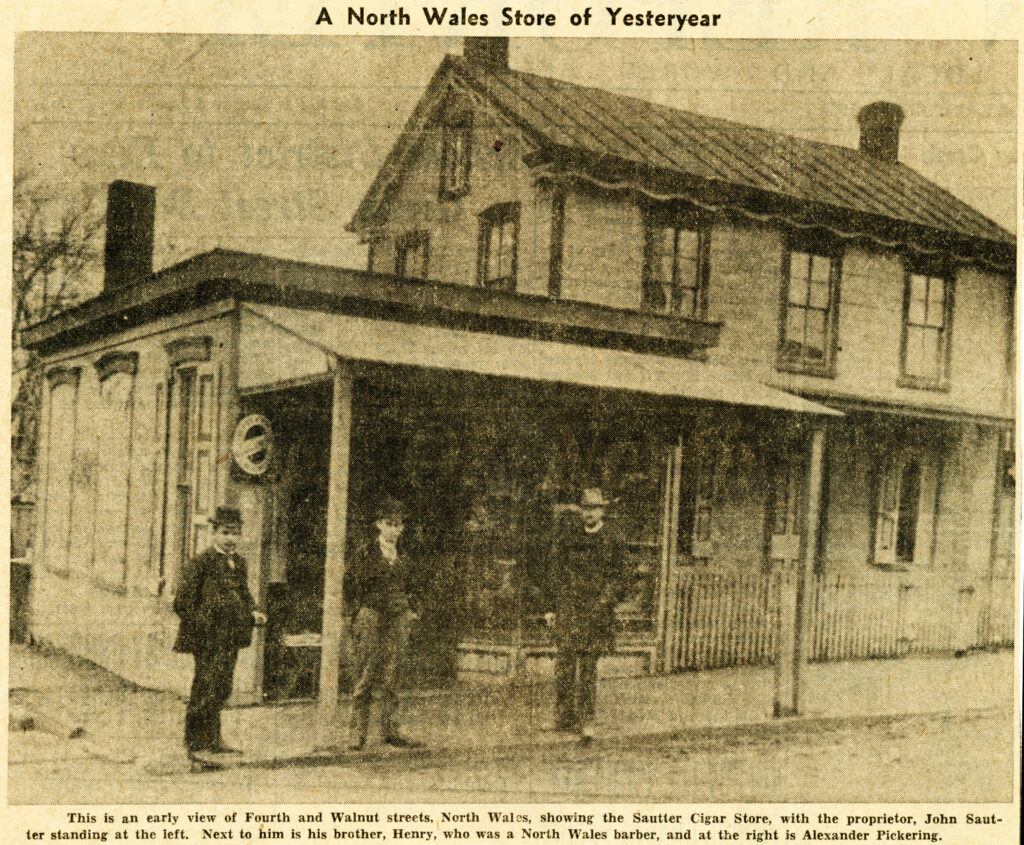
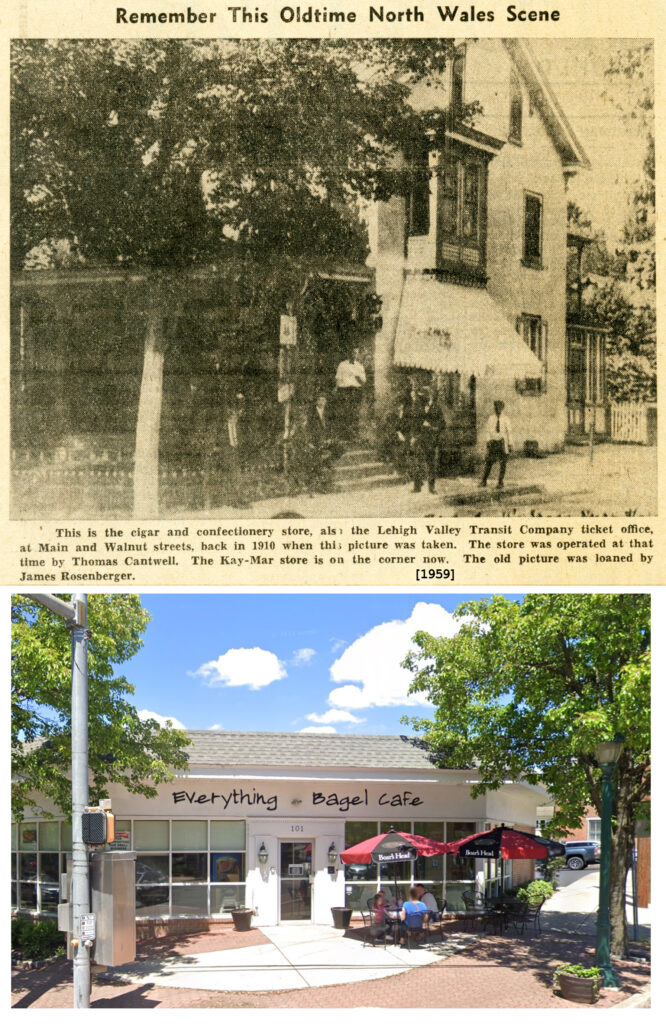
1906 photograph looking north-east on E. Walnut St. The post office building at left still stands today at 110 E. Walnut Street. A caption for this photo written in 1959 reads: “From left are the old Post Office, now Paul’s barber shop; the home of Nevin Kelly; Lear’s restaurant; store of Isaac Rorer; Kriebel’s grocery store; Sautier cigar store; and in the distance the old Weingartner cigar factory.”

At the council meeting of May 7, 1888, a petition was presented for a change in the time of putting out street lamps. The petition requested council to “have the street lamps lit all night and every night without regard of weather or face of the moon.”

At this same May 7, 1888 meeting council agreed to have notices printed to notify all persons that the council had resolved to “prohibit the use of slingshots and the playing of ball in the streets of the borough.” The constable was instructed to enforce this resolution.

At the meeting held May 21, 1888, the matter of keeping the street lamps lit all night was again brought to the attention of council when an adjourned meeting was held and the following minutes recorded:

“President Anderman stated the object of the meeting was to hear the opinion of the taxpayers regarding the movement to burn the street lamps all night. The expression of the meeting might help the council to decide what to do in the matter under consideration. The public was well represented. “President Anderman, after calling the house to order, invited anyone present to express his opinion relative to the street lamps. As no one responded to the invitation, Isaac G. Freed made a statement, giving the present cost, while the lamps burned until 10 o’clock and on only such nights when the moon is not shining, being about fifteen nights out of four weeks, a hundred and ninety-five nights or five hundred and eighty-five hours in a year, at a cost of about one hundred and fifty dollars a year; at that rate twelve hours a night and three hundred and sixty-five nights would amount to four thousand three hundred and eighty hours in a year, amounting to about six hundred and seven dollars, an increase in expense of about four hundred and fifty dollars.

“Elias K. Freed replied, showing the advantages of having lights burning all night, and giving his opinion in regard to cost as adding only about one hundred and eighty dollars and seventy cents, basing his opinion on experiment. H. S. Kriebel followed stating that the cost would be but a trifle more than at present.

“At a request made by H. S. Kriebel the petitions were again read. The petition favoring the burning of the lights all night was signed by about one hundred and thirty-six names, while that objecting to the extra expense involved in the change was signed by sixty-seven names, some of the signers appearing on both papers. The public having completed their task, council argued the matter for a while when A. K. Shearer moved that the first petition be accepted with this exception, that the lamps are not to be lit when the moon shines, until twelve o’clock at night and the sky is clear, but on rainy or stormy nights the lamps are to be lit at all times.”

The motion was carried five to one and the result was that the lights were to burn all night for the ensuing year.

The matter of fire protection had been considered by borough council from time to time over a period of years, but never seriously, until the meeting of September 7, 1888, when we find the following recorded:

“The protection against fire was next taken into consideration. After discussing the matter, it was on motion agreed to appoint a committee of two to purchase six hundred feet of Red Cross hose and two service pipes. R. R. Freed and A. K. Shearer were appointed the committee. It was further agreed to build a hose carriage house on the lockup lot, twelve by eighteen feet and nine feet high to square, of plain pine barn boards, tin roof, pitched both ways with ornamented front. Jacob H. Leister and R. R. Freed were appointed the building committee. On motion it was unanimously agreed that Frank Anderman, John Choyce and W. H. Barger be a committee to report at the next meeting the prices of hose carriages and other particulars about fire apparatus.”

This post is sourced from a column entitled Early North Wales: Its History and Its People penned by long-time North Wales resident historian Leon T. Lewis. The article appeared in its original form in the October 20, 1959 issue of the North Penn Reporter

EARLY NORTH WALES:  ITS HISTORY AND ITS PEOPLE, Part 32

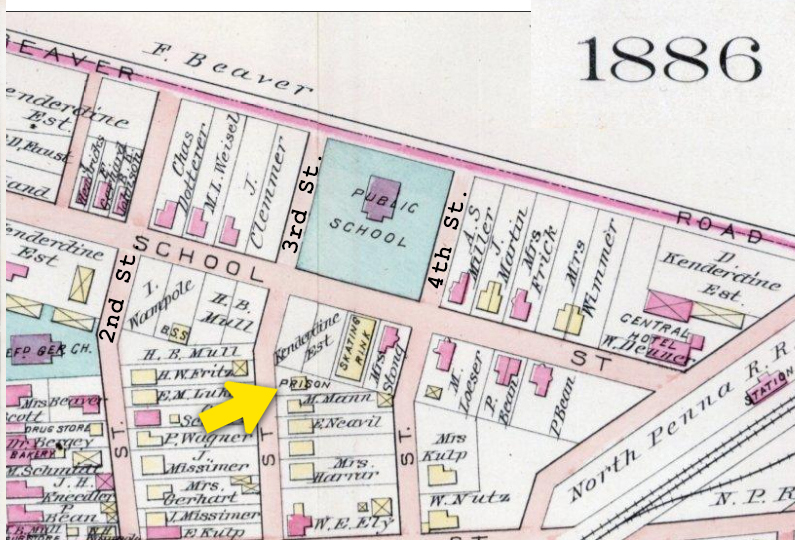
At a special meeting of North Wales Borough Council, held on February 17, 1885, the propriety of disposing of part of the lot upon which the lockup (borough jail) was erected was considered.  This lot was located on the northeast corner of Third and School Streets.

An offer of ten dollars was made for part of the lot fronting 51 feet on School Street, adjoining Mrs. Stong’s property on the northeast side. The offer was accepted and the president was authorized to dispose of the lot in the rear of Mrs. Stong’s property to her at five dollars.

The borough, having no convenient or suitable place in which to keep burning fluid (for street lanterns), ladders, etc, at the meeting of April 23, 1885, “it was on motion of Mr. Moyer agreed that the Committee on Street Lamps have a building erected in the rear of the lockup for that purpose, the same to be six by eight feet. Seven feet (height) to square of frame, shed roof of boards and sides and roof to be stripped.” This building was completed by June 1, 1885.

That a great number of hogs were kept within the borough is evidenced by the complaints that were received by council at almost every meeting.  Council acted quickly on the complaints and ordered the nuisance abated as soon as it arose.

After the General Election held on the 16th of February, 1886, council reorganized on March 1, and we quote from the minutes of that date: “After the business of the retiring council, Jonathan Scott arose and extended his hand to the retiring President Isaac Wampole, Jr., and congratulated him on the faithful and impartial manner in which he discharged his duties as president and member of council, and that he had the pleasure of being in council with him nine years ago and that he on more than one occasion had been specially benefitted by his just and wise counsel.

“Whereupon the president replied, saying he did not know that he had been of special benefit to anyone, but that he well remembered being in council at the time alluded to by Mr. Scott, that he always tried to do his duty to the best of his knowledge and understanding, that he has been a member of council for the last ten years less one month, and that the first seven years thereof spent in peace and their deliberations were harmonious and pleasant, but the last two years and eleven months have been very dissatisfactory to himself, as well as to others, and asked forgiveness if he wronged anyone, and that he forgave those whom he has just cause to claim have wronged him, and hoped that the ill will and hatred that has existed may die out with the adjournment of the present council, and to the new and incoming council said that he did hope and trust that all their actions and deliberations may be pleasant and founded on the principle of love and justice.”

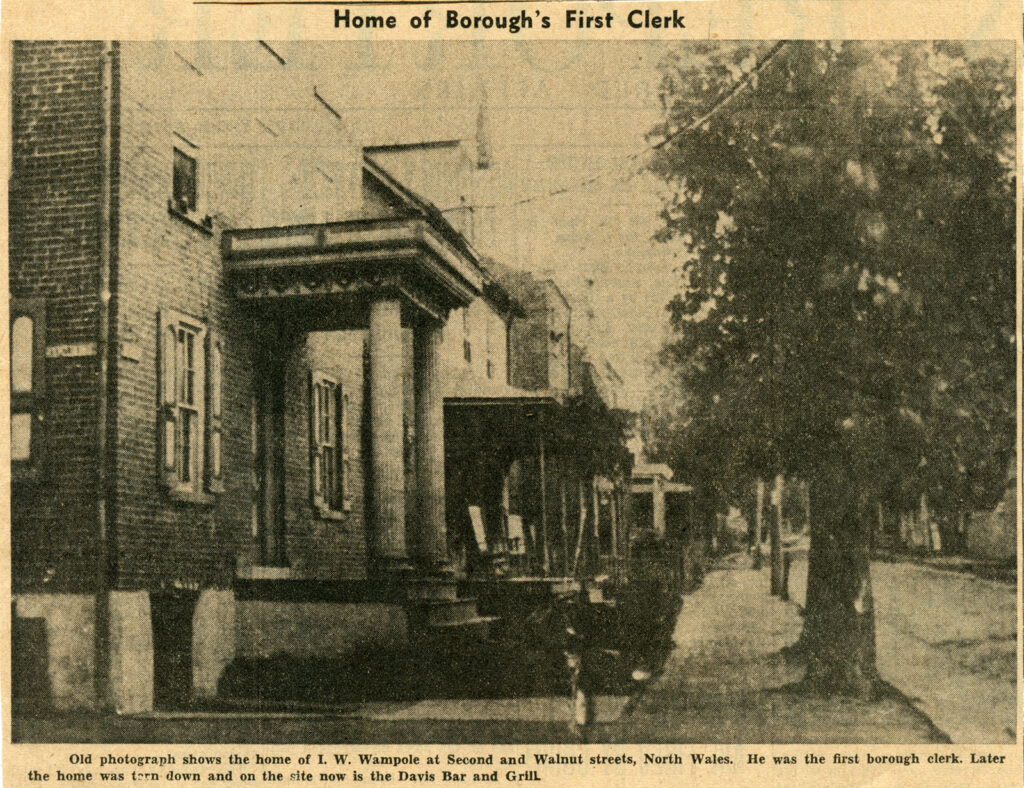
At this same meeting I. W. Wampole, clerk, was defeated on the fourteenth ballot by Isaac G. Freed. Mr. Wampole had served in the capacity of clerk for a period of fifteen years.

The meeting place of borough council was again changed on April 5, 1886 to the office of the clerk, Mr. Freed.

The matter of a water supply for fire protection had never been considered seriously by council until January 25, 1887, when at a special meeting of council, “Jonathan Scott, president, stated the business of the meeting was to consider a proposition of the North Wales Water Company to put in water hydrants for the use of the borough in case of fire, etc.” The following proposition was then read: “The North Wales Water Company agrees to erect 20 fire hydrants in the different streets of the borough for fire protection, and to have an ordinary supply of water in their tank at all times; but don’t agree to keep up fire under the boiler night and day, but will keep a good supply of dry kindling wood on hand and when the fire is drawn out, the kindling to be put under the boiler ready to fire up at short notice. The engineer to be instructed that in case of a fire in the borough, he is to get up steam and start the pump without delay so as to give the best supply of water to the hydrants as possible, for the sum of $150 per annum, or $7.50 per hydrant per annum.” This proposition was accepted by the council.

Up until this time there was no means of crossing the railroad on Pennsylvania Avenue at Washington Avenue, and on June 6, 1887, there appears in the minutes the following: “A petition signed by many citizens asking for a bridge across the railroad to connect Washington Avenue with Pennsylvania Avenue which are now separated by the North Penn Railroad which is in a deep cut at this place. After the reading of the petition, the propriety and impropriety of building such a bridge was fully discussed, and when much time was thus consumed a motion was made and seconded that the chair appoint a committee to view the site and ascertain the expense to build such a bridge and report to the council at the next monthly meeting. The motion was agreed to and the president appointed Frank Anderman, W. H. Barger, H. B. Mull, and John Choyce as a committee.

This post is sourced from a column entitled Early North Wales: Its History and Its People penned by long-time North Wales resident historian Leon T. Lewis. The article appeared in its original form in the October 13, 1959 issue of the North Penn Reporter

EARLY NORTH WALES:  ITS HISTORY AND ITS PEOPLE, Part 31

The right of H. C. Potter to fill the chair of the president of North Wales Borough Council still persisted at the meeting of April 23, 1883, when we find the following in the record:  “At a meeting held this evening at which all the members were present, on motion of B. K. Johnson, the proceedings of the council elect at their meeting held on the 2nd day of April 1883, which proved to be illegal, was annulled, and a proposition to proceed and organize was agreed to, the members of council having been previously duly affirmed according to law.

“B. K. Johnson was appointed chairman of the meeting and I. W. Wampole secretary. A communication was handed in by William A. Smith. William Miller and Isaak Wampole, Jr., were then nominated for president. Mr. Miller withdrew his name and Isaac Wampole, Jr., was elected president of the council by acclamation and took his seat as such.

“Isaac W. Wampole was nominated for clerk of the council. There being no other nominations, he was also elected by acclamation.

“Franklin S. Kriebel and Henry W. Moyer were nominated for borough treasurer and Smith and Johnson appointed tellers of election, and a ballot had which resulted in a tie vote. A second ballot was had which resulted in F. S. Kriebel receiving four votes, being a majority of the vote polled, was declared duly elected borough treasurer for the ensuing term.

“The communication handed in by William A. Smith was then read and found to contain what Hiram C. Potter claimed to be his resignation as president of the council, not having been elected president, although having declared himself to be. The same was neither accepted or rejected but simply received and filed.”

August 6, 1883, on motion of E. K. Freed, Dr. B. K. Johnson was appointed a committee to request the president of the Spring House and Sumneytown Turnpike Road Company to call a special meeting of the stockholders to vote on the question of granting the borough the privilege of using seven feet of their road on each side for a sidewalk and pavement so far as the same extends through the borough.

The borough was evidently expanding, for on August 13, 1883, the following motion was made by Dr. Johnson, “That a petition be got up for the extension of the borough limits and the lines for such extension be run and a draft of the same made as soon as practicable, which was agreed to.” The committee appointed for this extension reported on March 3, 1884, “Having seen J. M. Swartley, S. U. Brunner and H. R. Swartley, who are willing to sign a petition in favor of extension. On motion the committee was continued and instructed to procure a petition and get as many signers as possible, and if sufficient signers be had, to order a survey.”

At this same meeting the report of the Spring House and Sumneytown Turnpike Company granting the right and authority to the borough along each side of said turnpike road for the use of pavements, to be kept in repair by the borough was read and accepted. Dr. Johnson was continued the committee on this matter and was authorized to have a lease drawn and executed between the borough and the turnpike company for the term of ninety years. This lease was presented and accepted by the borough on May 5, 1884.

In order to keep the streets of the borough free from loungers, the following ordinance was passed by council on June 2, 1884:

“That all persons found lounging at street corners, post office, stores or other public places within the borough of North Wales, or obstructing the entrance or passageway to a church, shall be arrested and on conviction pay a fine of two dollars and fifty cents for each offense, and the costs of prosecution, and in default of the payment of the same shall be confined in the lockup for a period of not less than twelve hours.”

Those of us who pass over Main street today cannot visualize the condition it was in on June 5, 1884, when George Kreamer claimed seven dollars as damages for being stranded with his team of horses on Main street, the street having been recently filled and a heavy storm raging at that time. After considerable discussion Mr. Kreamer’s bill was paid.

The extension of the borough limits again held the attention of council on August 8, 1884, when the committee reported that a majority of the property owners, residing in the proposed new district, had signed in favor of the extension.  Accordingly a special meeting was held on August 5 for the purpose of agreeing upon the lines of the proposed extension. On behalf of the committee, Isaac Wampole presented a plot plan taking in part of Samuel R. Gordon’s land, Jacob Swartley, Joseph W. McCracken, Elizabeth Ruth, William T. Ray, James Z. Wambold, Abel Penrose, S. U. Brunner, Jacob L. Young, I. M. Harley, Catherine Haas, Jacob Zebley, Harry Swartley and Joseph K. Anders, The plan was agreed to and the committee instructed to have a survey made.

This post is sourced from a column entitled Early North Wales: Its History and Its People penned by long-time North Wales resident historian Leon T. Lewis. The article appeared in its original form in the October 6, 1959 issue of the North Penn Reporter

EARLY NORTH WALES:  ITS HISTORY AND ITS PEOPLE, Part 30

Main street was owned by the Spring House and Sumneytown Turnpike Company and maintained by the company. It is evident from reading the North Wales Borough Council minutes that the turnpike company was lax in keeping the street in a condition of repair that was satisfactory to the council.  On November 8, 1882, council passed the following resolution: “President Scott and B. K. Johnson were appointed a committee to secure by purchase, or lease, from the Spring House and Sumneytown Turnpike Road Company that portion of their road within the limits of the borough of North Wales, and the extension of the same when extended.”

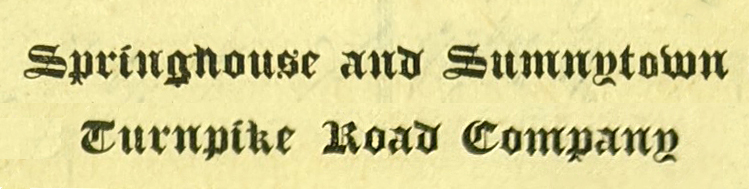
Springhouse & Sumnytown Turnpike Road Company letterhead. Between 1848 and 1914, this private company owned and operated what is today known as Sumneytown Pike. All users including bicyclists paid tolls. Courtesy of Historical Society of Montgomery County

On February 5, 1883, the committee reported that they had met the board of managers and stock-holders of the company at their annual meeting held at Mainland on the 8th of January 1883, and that the proposition to purchase or lease was rejected.  A committee was appointed on behalf of the turnpike company to meet the council committee and confer in reference to granting permission to the authorities of the borough to make sidewalks and pavements on their road.

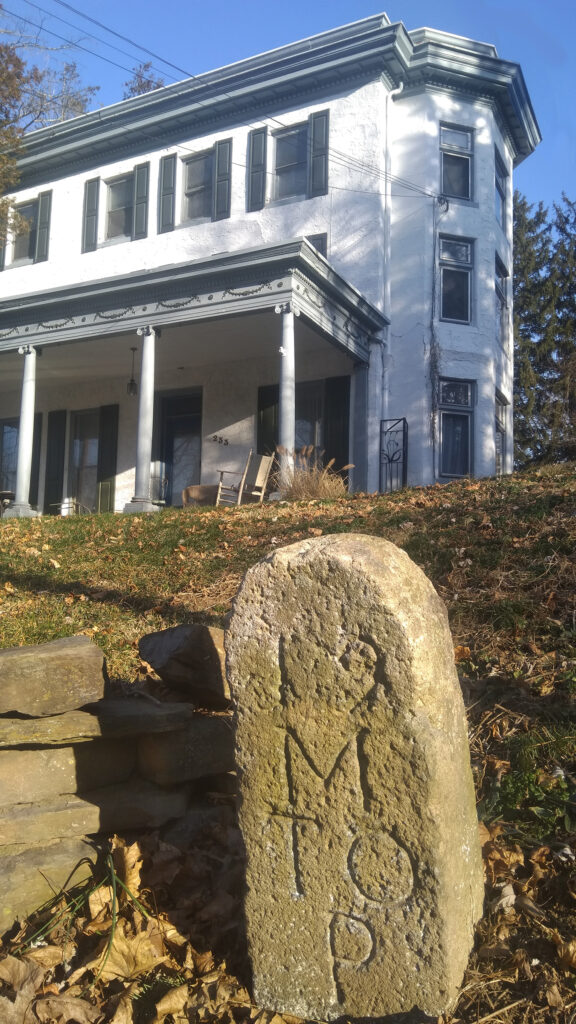
Sumneytown Turnpike mile marker still stands at 233 S. Main Street in North Wales borough. Toll houses were located both north and south of town. Kneedlers toll house stood at the intersection of Sumneytown Pike and West Point Pike. Van Fossen’s toll house stood south of town, on the Pike near the present-day intersection with Gwynedd Manor Road (south). Mike Szilagyi photo

Council apparently had troubles and disagreements as far back as 1883, as is shown by the following minute of the meeting of April 2 of that year which is quoted in full: “The burgess and members of town council of the Borough of North Wales elected February 20, 1883, for the ensuing term met this evening at the office of I. W. Wampole, being councils regular place of meeting, for the purpose of organizing the transacting such business as may require their attention. Hiram C. Potter, burgess-elect, announced that he was already sworn into office as burgess of the Borough of North Wales and produced a certificate of oath in due form, which however, was not filed among the records of the corporation as required by law, and that upon a former occasion when elected to the same office he was not legally sworn in and that his oath then was of no account.

“A. W. Dettra, a justice of the peace, having administered the same, as appears from the council’s records, informed the members-elect of the town council, all of whom were present, that they could now be sworn into office by him or by a justice of the peace.  They decided to be sworn in by the latter. Isaac Wampole, Jr., Elias K. Freed, Benjamin K. Johnson, William A. Smith, William Miller and Peter Lalley  were then duly affirmed according to law, to support the Constitution of the United States of America and that of the Commonwealth of Pennsylvania and perform the duties of their offices as members of the town council of the Borough of North Wales respectively with fidelity, by I. W. Wampole, a justice of the peace in and for the County of Montgomery, Pennsylvania.

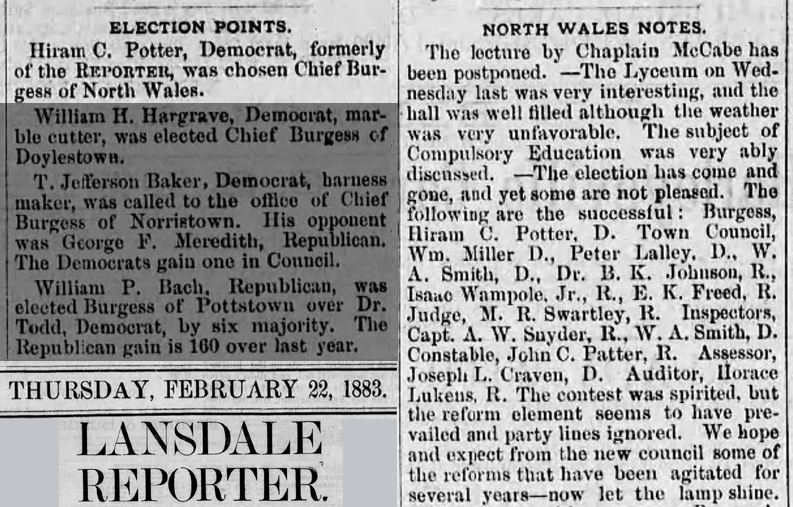
February 22, 1883 Lansdale Reporter article regarding the election of borough officials in North Wales. “The election has come and gone, and yet some are not pleased… The contest was spirited, but the reform element seems to have prevailed and party lines ignored. We hope and expect from the new council some of the reforms that have been agitated for several years – now let the lamp shine.” For added context, the paper reports that Hiram C. Potter is a Democrat and is “formerly of the REPORTER.”

“Hiram C. Potter was then appointed chairman of the meeting and I. W. Wampole secretary. B. K. Johnson, E K. Freed and H. C. Potter were then nominated for president of the council. B. K. Johnson withdrew his name as a candidate. A ballot was then had which resulted in a tie vote. William A. Smith insisted upon the right of the burgess to fill the office of president of council and give the casting vote in the case of a tie. Smith asked E. K. Freed to withdraw his name in favor of the burgess, which he declined doing. A second ballot was then had which resulted in H. C. Potter receiving three votes and E. K. Freed two, with one blank ballot being cast. H. C. Potter thereupon declared himself duly elected president of the council for the ensuing term.

“For clerk, I. W. Wampole and Charles Meredith were nominated, whereupon William A. Smith urged the claims of the latter saying that he would perform the duties of the office for twenty-five dollars.  The former nominee was asked if he would accept the office at the same sum.  He told the Council explicitly that he would not perform the duties of the office including office rent, light, fuel, stationery and the safe keeping of the records of the corporation for less than forty dollars. Considerable discussion was indulged in regarding the clerkship, and a ballot had which resulted in I. W. Wampole receiving a majority of votes polled.  He was declared duly elected clerk of the council for the ensuing term.”

The right of H. C. Potter to occupy the position of council president was carried over to the meeting of April 20, 1883, when, “At a meeting of the town council of the Borough of North Wales held agreeably to adjournment, all the members being present, but owing to the persistent determination of Hiram C. Potter to force himself upon the council and be recognized as its president, to which office it was well known he had not been elected, notwithstanding his declaration he was, no business was transacted, and after a suggestion made that the Council meet on Monday evening, April 23rd, 1883, for the purpose of effecting a legal organization, the members withdrew.”

This post is sourced from a column entitled Early North Wales: Its History and Its People penned by long-time North Wales resident historian Leon T. Lewis. The article appeared in its original form in the September 29, 1959 issue of the North Penn Reporter

EARLY NORTH WALES:  ITS HISTORY AND ITS PEOPLE, Part 29

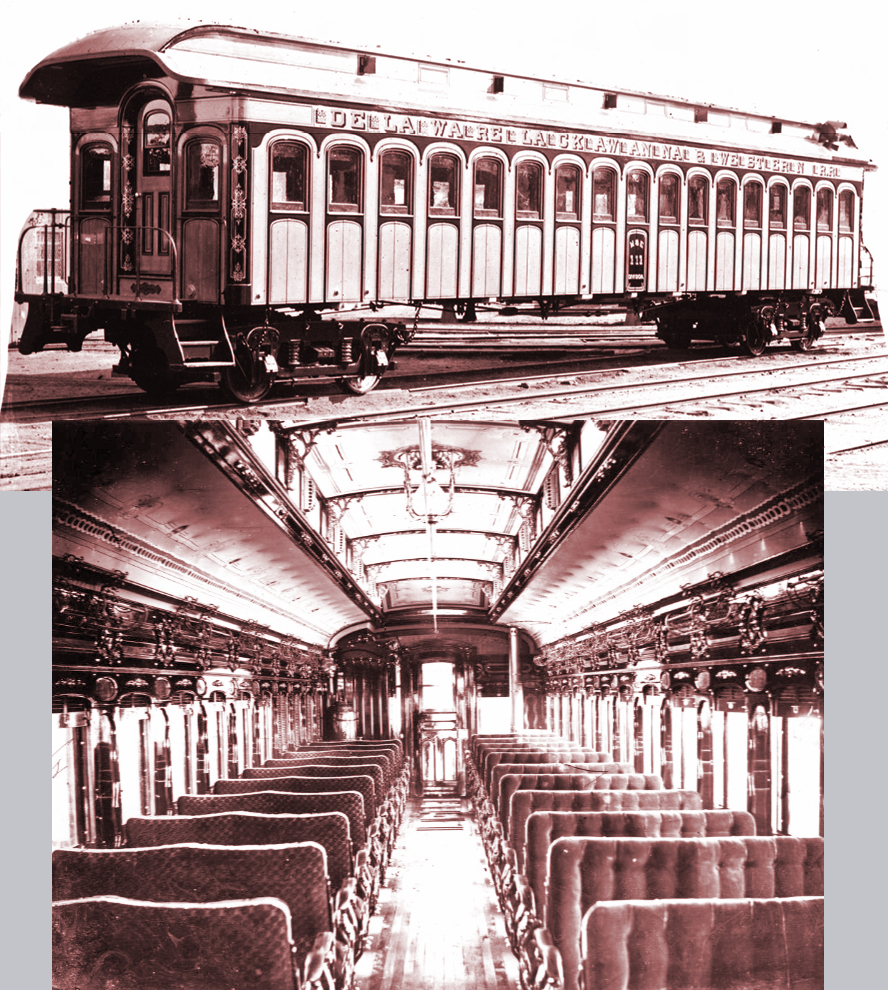
The following paragraph appeared in the first edition of the North Wales Record, August 8, 1874: “During the present summer the North Pennsylvania Railroad Company have increased their rolling stock by the addition of a number of handsome passenger coaches. The new cars are not only models of beauty, but also of com­fort. The interiors are handsomely frescoed and the paneling is of pol­ished walnut. They are also much larger than the old cars and are furnished with marble-top station­ery wash-stands at each end. We have also been informed that the company intends running this style of cars over the Stony Creek Railroad, and that they will be placed on the line in the fall.”

Although not a North Penn Railroad car, this is an example of the style of steam-hauled railroad passenger cars built in the 1870s. The railroad car in this illustration was built by the Jackson & Sharp Company in Wilmington, Delaware.

Sensing the noise that usually precedes a Fourth of July, North Wales Borough Council on June 3, 1878 passed the following resolu­tion: “‘that all persons be cautioned against firing any gun, or other fireworks within the Borough of North Wales at any time other than the 4th day of July as the same is a violation of a state law and all persons offending are liable to a prosecution, and if convicted, forfeit and pay five shillings for every such offense, and on refusing to pay the same to undergo an im­prisonment for the space of forty-eight hours in the county jail.”

The following is a report of the property taxable for borough pur­poses in 1878, at the rate of four and one-half mills:

Improved Real Estate     $175,956.00
Unimproved Real Estate6,757.00
Yearly Income   17,155.00
Horses (48) valued at 2,370.00
Cows (6) valued at 170.00
Carriages (27) valued at1,530,00
 Total$203,938.00

The clatter of the galloping feet of a run-away horse and the re­sounding crash when horse and buggy collided with a lamp post, resulted in the following motion on July 1, 1878: “On motion resolved that a bill of damages be presented and collected from John Markley for lamps broken on Shearer street by the running away of a horse in charge of W. Weber, an employee of said Markley.”

That council took excellent care of the lodgers in the lock-up [borough jail] is evi­denced by the following notation in the minutes: “Doctor W. E. Ely presented a bill of one dollar for medical attention and medicine for T. Boyd, an inmate of the lock-up on the 26th of February 1879, which, on motion, was paid.”

On December 6, 1880, council passed a resolution which was an attempt to correct a very danger­ous condition that existed at that time at the crossing of Main street by the railroad. The resolution reads: “Resolved that the Philadel­phia & Reading Railroad Company be notified to extend their culvert on Second street in the borough of North Wales to a length sufficient to make it safe from accidents in crossing over the same, and that the action of the Grand Inquest of the County of Montgomery recom­mending a flagman to be stationed at Main street where the North Penn Railroad crosses the same in said borough to avert the immi­nent danger which persons crossing said road at that point are daily subjected to, be complied with by said railroad company without fur­ther notice or unnecessary delay.”

On April 4, 1881, a petition was presented to council for the exten­sion of the borough limits, and a public meeting was called on Monday evening, April 11, 1881, in Kiles Hall, to take into consideration the propriety of such an extension. There is no record in the minutes of the action of this public meeting.

The town well pump again occupied the attentions of council, when September 5th, 1881, “a petition praying the town council to put new floor on and a good pump on the well between Kiles Hotel and Harley’s store [Lumber Street], and in case the well should not prove sufficient, then at the earliest date possible enlarge and deepen it until it will be suf­ficient for all public purposes at the expense of the taxpayers, was pre­sented, and on motion received and resolved that a new floor be put on and a new pump be put in said well, as prayed for by the petitioners and that no water be taken therefrom for any other than culinary pur­poses, except by those having per­mission to do so by deed, and in case of fire, and that the pump be so constructed as to take the water out to within eighteen inches from the bottom of the well.

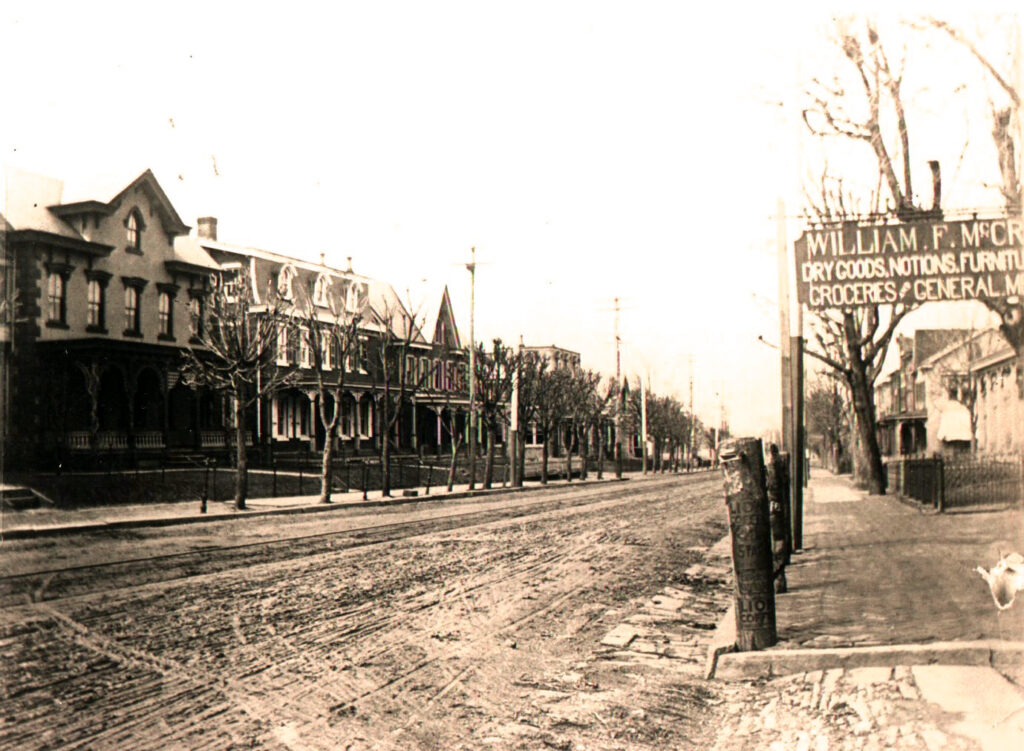
The photographer has set the tripod on the east side of S. Main Street, and aimed the lens to the north. The house on the left is 108 S. Main Street. The curb at lower right is for Lumber Street. Note the tidy brick sidewalk and carefully pruned street trees.

Desirous of keeping pace with the progress of the times, Borough Council changed the construction of all pavements by the following ordinance adopted on April 3, 1882 “That all new pavements shall be of brick, slate or stone, with proper curbing, and no stone to be laid less than two feet square with a smooth surface, and that all board [wood] pavements in said borough upon becoming dilapidated and requiring new string pieces, shall be removed and replaced with brick, slate or stone.”

On August 7, 1882, a petition was presented to council for the enact­ing of an ordinance prohibiting fowls from running at large in the borough. This petition was laid over for action at the next meeting.

The result of tree limbs overhanging the streets was evidenced at the September 4, 1882 meeting of council when Hunter Van Leer presented a bill of two dollars due by him to Sylvester Bright for repairing a carriage which was injured in con­tact with a limb in the borough, and claimed that the borough should pay the same. This bill was paid by council on October 16, 1882.

This post is sourced from a column entitled Early North Wales: Its History and Its People penned by long-time North Wales resident historian Leon T. Lewis. The article appeared in its original form in the September 22, 1959 issue of the North Penn Reporter

EARLY NORTH WALES:  ITS HISTORY AND ITS PEOPLE, Part 28

The results of the desire to quench ones thirst, with something other than water, aroused the ire of the Borough Council. At the meeting in April 1872 it was unanimously resolved, “That all persons hereafter found intoxicated, or under the influence of liquor within the Borough of North Wales, be arrested and fined in the sum of $2, to which the constable shall be entitled for his service in attending to the lockup in the lodging of stragglers and criminals, etc.”  [Two dollars in 1872 is roughly equivalent to $50 today.]

In October of 1872 the street commissioner was instructed to notify persons having trees near street lamps to keep the trees trimmed so as not to obstruct the ray of the light from such lamps on to the pavements.

Many years ago it was the custom for every community to have a local pump and well containing drinking water for both humans and animals. Such a pump and well was located on Lumber street, which runs between Main street and Second street along the Peoples Savings and Loan Association [in 2024 The Green Fork], and on May 7, 1873, it was resolved, “That the pump in the well on Lumber street, near Harley’s store, be repaired or replaced by a new one and the well covered with a good plank floor.”

This photo looks south on 2nd Street from the intersection of 2nd Street and Walnut Street. In 2024 Tex Mex Connection restaurant occupies this corner.

At the December meeting in 1873, the meeting place of Council was changed from the office of I. W. Wampole to the office of the North Penn Fire Insurance Company, for which the council paid a rental of ten dollars per year.

Between the April and May meetings of 1874, an election was held at which the following were elected: Burgess, Samuel H. Shearer; Councilmen, Jacob H. Leister, Henry B. Mull, David Richards, David Baker (local undertaker and carpenter), Sylvester Bright and Evan B. Kepler. At the reorganization meeting of this newly elected council, I. W. Wampole was replaced as borough clerk by A. W. Dettra. It might be interesting to note that at this time the borough council was completely democratic.

December 2, 1874, on motion the President was ordered to inform the Court that the Borough of Lansdale had not provided a lockup, as is required by law, and that our lockup was over-crowded in consequence thereof.

March 3, 1875, on motion, the president was instructed to collect $8.50 of Samuel W. Hendricks for the destruction of a lamp on Main street in front of the estate of Jonas D. Moyer. This was paid at the May meeting.

As a result of numerous street lamps being broken, council, on May 6th, passed the following ordinance: “That hereafter any damage done to the public lamps, or other property belonging to the borough, by any boy or boys; the parents, guardians, trustees or whosoever may have such boy or boys in charge, will be held responsible for all costs that may arise in repairing said damage in addition to a fine of $1 for such offense.”

During June, July and August of 1875 the lighting of the street lamps was dispensed with. Evidently this was done because of the long summer evenings.

In April 1876, council again desired to change their meeting place and accepted an offer of Abel K. Shearer to meet in his office for a rental of $1 for each meeting night, light and fuel included.

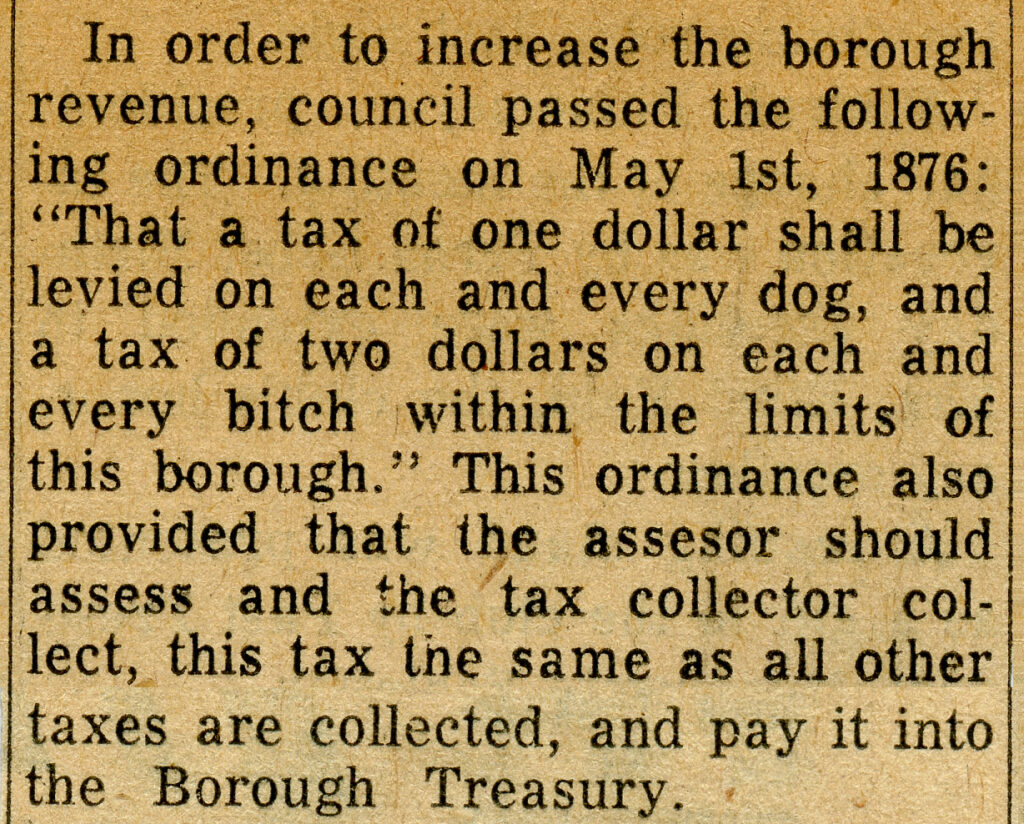
In order to increase the borough revenue, council passed the following ordinance on May 1st, 1876: “That a tax of one dollar shall be levied on each and every dog, and a tax of two dollars on each and every bitch within the limits of this borough.” This ordinance also provided that the assessor should assess, and the tax collector collect, this tax the same as all other taxes are collected, and pay it into the Borough Treasury.

Following the general election of 1877, the new council met and organized on April 2, 1877, at which time I. W. Wampole was reappointed clerk. At this meeting Abel K. Shearer again offered the council the use of his office in which to hold their meetings at one dollar per night, which was not accepted, and Council decided to again meet at the office of the clerk.

After having considerable trouble with the street lamps, the following report was made to council on May 7th 1877:

“The committee on lamps reports several in good condition, one broken and others requiring too much oil. The lamp lighter being present, having experimented with the lamps, reports that several, when filled, burn out in two evenings, while others with the same amount of oil burn six evenings, upon which a lively discussion ensued, and a motion made and seconded to dispense with lights for four months, which was not agreed to. The committee was then instructed to examine new lamps and if they find them to answer a good purpose and save oil and time to light them, as is claimed by the lamp lighter, to get more of the same kind to take the place of the old ones now in use.”

This post is sourced from a column entitled Early North Wales: Its History and Its People penned by long-time North Wales resident historian Leon T. Lewis. The article appeared in its original form in the September 15, 1959 issue of the North Penn Reporter

EARLY NORTH WALES:  ITS HISTORY AND ITS PEOPLE, Part 27

Referring again to the Borough Lockup, it is apparent from the borough council minutes that by this time the demand for lodging had become so great that council found it necessary to equip the lockup with benches. mattresses and blankets at a cost of $11.50.

High Constable Weikel, in charge of the lockup, reported at the meeting of March 1, 1871, that he accommodated 29 persons with lodging in the lockup since July 1870, to date, eleven of whom were from Ireland, eight from Germany, one from England, four from the state of New York, one from Maine and two from Pennsylvania. Among them were four females, all Irish.

The reputation of the accommodations at the lockup evidently spread far and wide, for on March 6, 1872 Constable Weikel reported that he had accommodated sixty-six persons from March 4, 1871, to March 1, 1872, one of whom was born in Connecticut, two in England, three in the state of New York, and three in New Jersey, five in Pennsylvania, sixteen in Germany and thirty-six in Ireland. Four of these were females: one American, one English, and two Irish.

There were also four prisoners confined in the lockup within said term.

The popularity of the lockup became so great that in February 1877 the lockup committee reported it in good condition, but too small to accommodate all the applicants for lodging. However, this lockup continued to house the traveling guests of the borough until May 5, 1890, when the building was sold to Mary Axer for $275.

On October 6, 1890, council instructed the lockup committee to proceed at once with the construction of a new lockup on the ground which council had purchased at the rear of the Hose House at Third street and Montgomery avenue.

On November 2, 1891, the lockup committee reported that the new building was completed with the exception that “it wants straw for the beds”, which was supplied on December 7, 1891, along with blankets. This lockup was in operation until recently [1959] when the cells were torn out and it was turned into a storage house for the borough equipment.

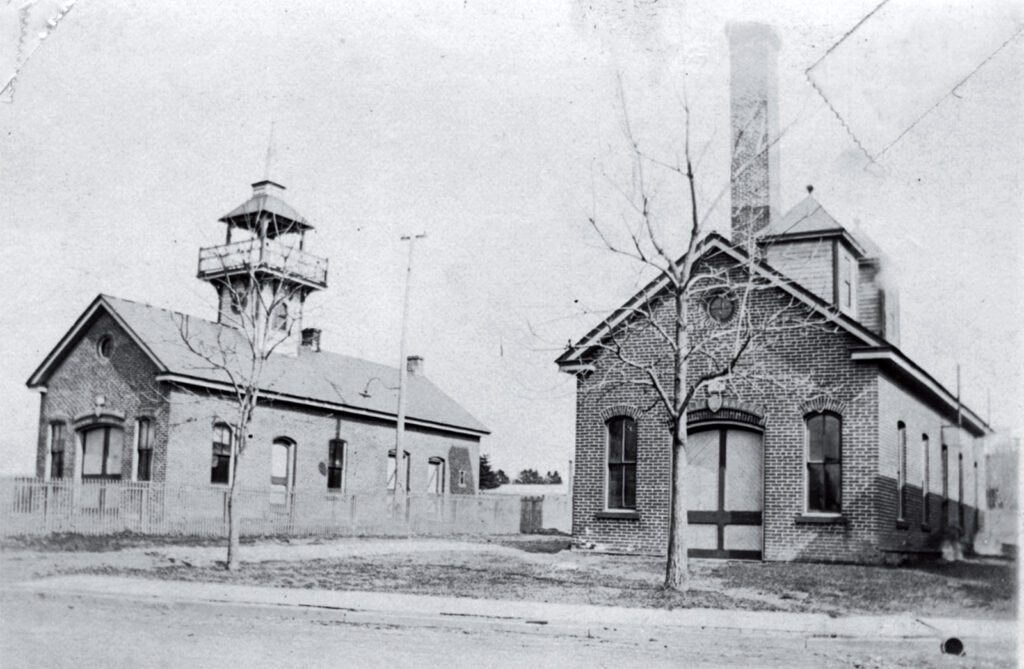
The southeast corner of 3rd & Montgomery Avenue was the site of the North Wales Hose Company (left) and the North Wales Water Company (right).  In 1891 a new borough lock-up was added to the rear of the fire house.  This fire house has been torn down, but the former water works building still stands. In 2024 it is home of Ewenited Stitches yarn store.

Another very important matter was discussed on December 7, 1870, when on motion, the name of Main street was changed to Wales street, Chestnut street to Church street, Washington avenue to Washington street, Broadway to School street and Depot street to Montgomery avenue.

A thorough search of the borough records fails to reveal when Wales street was changed back to Main street.

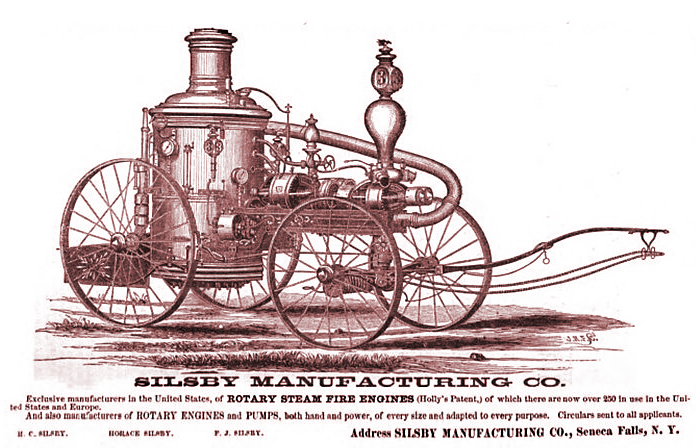
Fire protection for the town must have been seriously considered by the council at this time, for on May 3, 1871, a photographic show card and descriptive catalogue of the Silsby Engine for extinguishing fire was presented to council by Doctor Kennedy.

1870 advertisement for the Silsby Steam Fire Engine

As we said at the beginning of these last few articles, we do not intend to quote verbatim every minute contained in the records of council and, therefore, we are only offering those things which we feel are interesting and historical. It must be remembered. however, that during all this time council was busy ordering the laying of sidewalks, all of which were constructed of boards, opening streets, paving streets and in general doing those things which were necessary for the creation of a thriving borough.

Every meeting of council found it necessary to borrow money in order to meet expenses. There was no bank in the borough at that time and it was impossible, therefore, to borrow on the contemplated taxes, so it was necessary at every meeting to appoint a committee, comprising one councilman, to contact a citizen who was public-spirited enough to loan council sufficient money to function. The records show that there were many such citizens.

In April 1872, spring was in the air and the itinerant merchant who went from door to door selling his wares, and the wandering doctor, who parked his show in front of the local livery stable and by the aid of a few smoking oil lamps proceeded to dispense medicine that he guaranteed would cure anything from a wart to a broken bone, arrived in town. The exhortations of the merchant and the echoes of the prognostications of the licorice water dispenser had hardly died down, before the wrath of council, in order to protect the local businessmen, descended on the heads of these nefarious vendors in the form of the following ordinance:

“That no theatrical exhibition or exhibitions of circus performances or menageries, stage plays, rope dancing or other shows or exhibitions of a like nature, or the sale of soap, medicine or other commodity put up in boxes, packages, or otherwise, containing a prize, shall hereafter be allowed within said borough without a license from the borough, which may be granted by the burgess upon the payment of a sum not exceeding ten dollars for the use of the borough, and if any person, or persons, shall attempt to violate the provisions of this ordinance, he or they, so offending, shall forfeit and pay the penalty of not less than five dollars or more than fifty dollars, to be recovered with costs as debts of like sums are now collected.”

This post is sourced from a column entitled Early North Wales: Its History and Its People penned by long-time North Wales resident historian Leon T. Lewis. The article appeared in its original form in the September 8, 1959 issue of the North Penn Reporter

EARLY NORTH WALES:  ITS HISTORY AND ITS PEOPLE, Part 26

A General Election was held on October 11, 1870, at which time 81 electors voted.

The result of the election is contained in the certificate issued by the judge and inspectors of election, who certified there were fifty-seven ballots in favor of street lamps and twenty-four for “no lamps.” Abel Lukens was judge, and Elias K. Freed and A. K. Shearer were the inspectors of the election.

Seven days after the election, or October 18, 1870, council held a special meeting “for the purpose of making arrangements for procuring and putting up streets lamps in pursuance of the result of the election held on the question of lamps. On motion of Mr. Freed it was unanimously resolved that as the question was determined in favor of lamps, a committee of two be appointed whose duty it shall be to examine the kind of street lamps now offered to the public by different manufacturers, and the cost of the same, and ascertain the number required, and report at the next stated session of the council, and procure and put up such and at such points and in such manner as shall be determined upon by the council. Elias K. Freed and Henry F. Moyer were appointed said committee.”

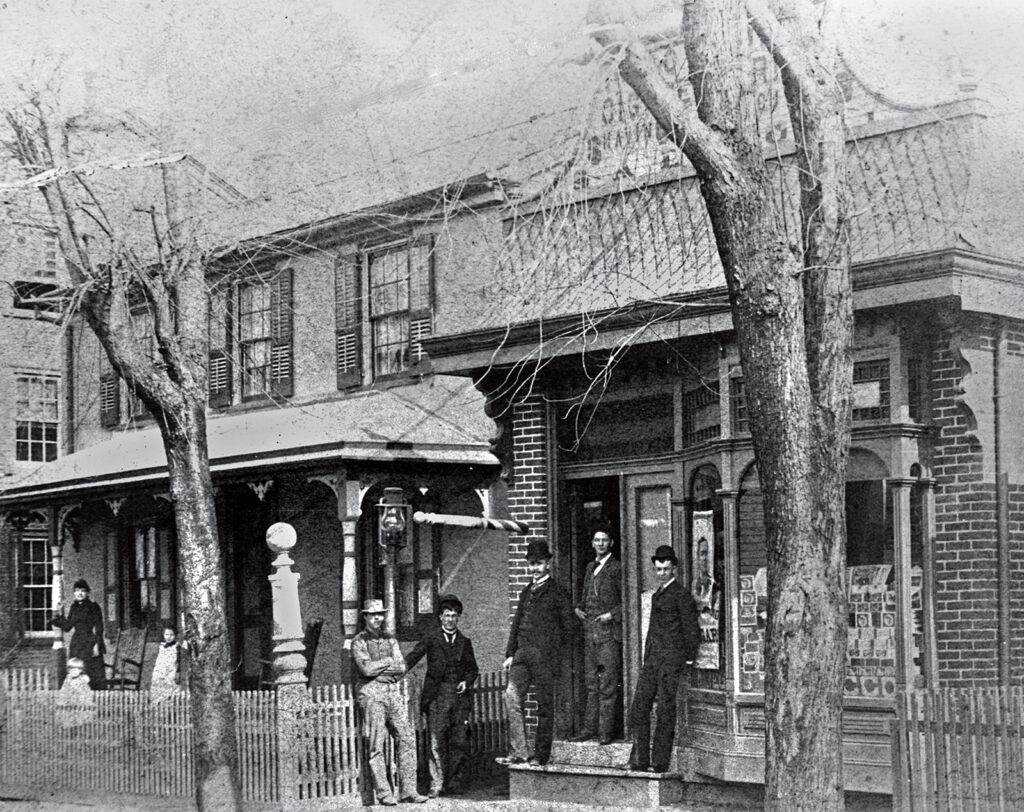
An early street lamp can be seen between the two men standing against the fence. This was the home and barber shop of Isaac Rorer on S. Second Street, neither of which stand today.  This is now the parking lot behind Tex Mex Connection.

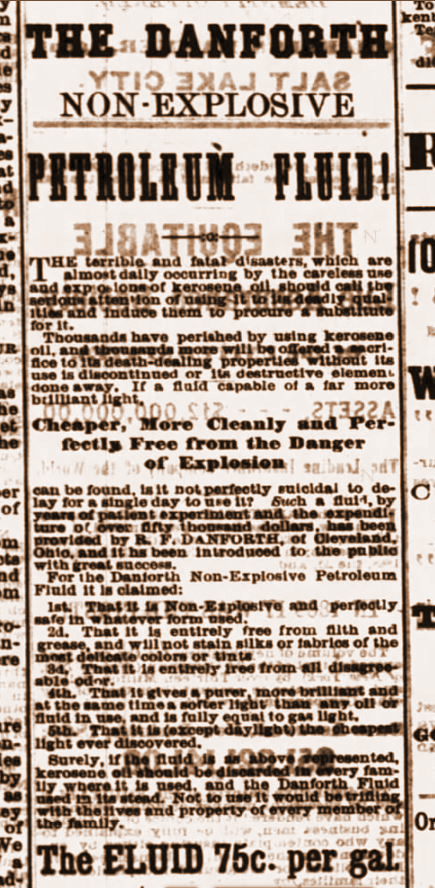
Council further considered the matter of street lamps at the meeting held on November 2, 1870. when the committee on lamps made a report in which they designated the following as proper points at which to erect the requisite number of street lamps, to wit, at the southwest corner of Washington avenue on Main street, at the northwest corner of Jonas D. Moyer’s lot, at the northeast corner of Lumber and Main streets, at the southeast corner of Walnut and Main streets, and one opposite the Reformed Church on Main street. At the southeast corner of Second and Depot streets, one opposite Lumber in Second street, one at the southwest corner of Second and Walnut streets, and one opposite John Mann’s lot in Second street. One at the northwest corner of Third and Walnut streets, one at the northwest corner of Third, Fourth, Fifth and Sixth streets on Montgomery avenue; and that they have examined different kinds of street lamps and recommend the Danforth’s Non-Explosive Petroleum Fluid[i] lamp which are offered at $96 per dozen. The report was accepted and the committee instructed to purchase the lamps as recommended and to have them erected on “good wooden lamp posts, unless others equally good can be procured at less expense.”

1870 advertisement for Danforth “Non-Explosive” Petroleum Fluid which was in fact naphtha

Street lamps again occupied the attention of council, when, at the meeting held on December 7, 1870, it was resolved that the names of the streets be painted on the four sides of the lamps and that the time to light the lamps be at candle light, or dusk, and that they be extinguished at 10 o’clock p. m.

It was further resolved at this meeting that sealed proposals be received by the committee on lamps until Wednesday evening, December 15, 1870, at 5 o’clock, for lighting, extinguishing, keeping clean, etc., the street lamps for one year.

In compliance with this resolution Messrs. Freed and Moyer, the committee on lamps, reported at the meeting of January 4, 1871, “that they have awarded the contract for lighting, extinguishing, cleaning, etc., sixteen lamps, to Michael Hasty at forty-five dollars for one year, from the 15th day of December 1870, and that the lamp lighter be allowed an appropriation of seventy-five cents per quarter for matches.”

At some point presumably the Danforth light fixtures were replaced with safer ones, once it became known how dangerous the Danforth “Non-Explosive” fluid was.

On July 6, 1896, the lamp committee was ordered to notify the lamp lighter to light the street lamps on all nights “that the moon does not give light”, until one o’clock.

The matter of street lighting continued to receive the attention of borough council, and on May 7, 1897 the following resolution was adopted: “Resolved that articles of agreement be made with a proposed electric light and power plant to be known as The North Wales Electric Light and Power Plant, as soon as it is incorporated, under which, the said proposed company shall be given the franchise to plant poles and string wires on the streets of the borough. Said franchise to be exclusive for ten years, and a contract to light the streets of the borough for a period of ten years with not less than fifty 25 candle power lights, at the rate of twelve dollars per year per light, be entered into with said proposed light company.”

One month later, June 7, 1897, borough council ordered its officials to enter into an agreement with E. K. Freed for street lighting, which was done. Thereafter, the street lighting was furnished by the E. K. Freed Electric Light Company, which erected its power plant on the Third street on the ground now [1959] occupied by Stainless, Inc.

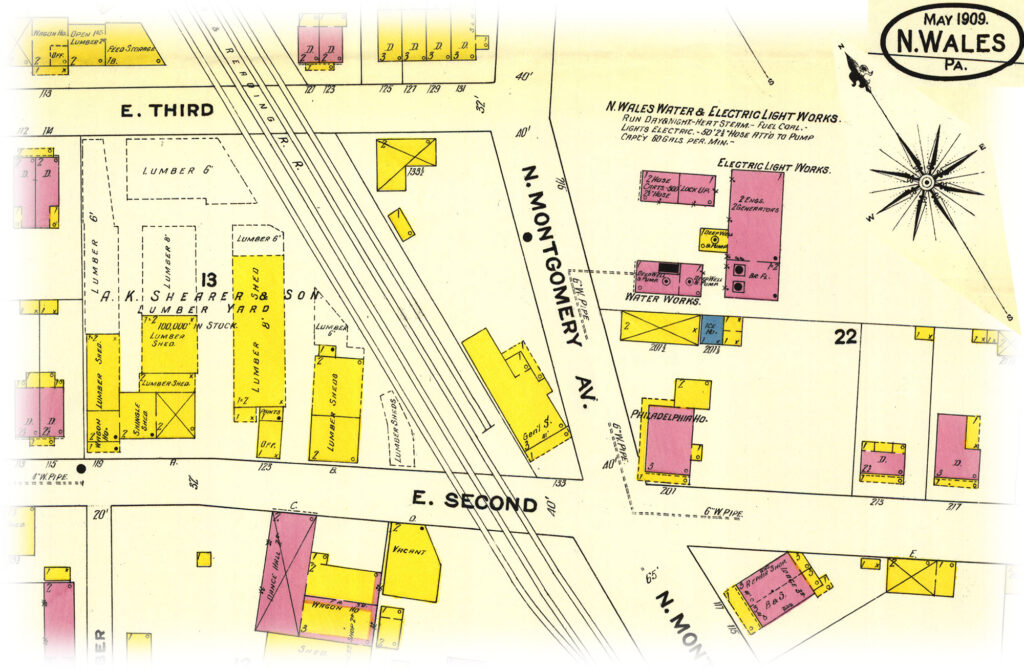
The upper right corner of this 1909 map shows E.K. Freed’s electric power plant. With no rail siding, coal to fuel the boilers needed to be hauled by teamsters’ horse-drawn wagons one block from the railroad. The building still stands, fronting on 3rd Street.

The fate of the old lamp lighter was doomed with the following entry in the borough minutes of October 4, 1897, “the lamp lighter is to be disposed of due to the erection of electric lights. All old oil lamps and poles to be removed and sold at $2 for the best, $1.50 for next best and $1 each for the worst.”


[i] In spring 1870, Danforth’s oil was a relatively new product in an unregulated marketplace. Without safety testing, manufacturers experimented with and sold highly flammable, unstable oils. [After a series of tragic fires] New York City’s Board of Health conducted a review of Danforth’s Non-Explosive Petroleum Fluid … and concluded that the New York-based product was no less than a “murderous oil.” It turned out that, while not technically “explosive,” the lamp oil would spontaneously ignite at room temperature without provocation. – La Crosse (Wisconsin) Tribune May 16, 2015.  “The oil sold by this firm (G. M. Danforth & Co.) is naphtha – nothing more or less; it is the most dangerous article that can be put into a lamp.” – First Annual Report of the Board of Health of the Health Department of the City of New York, 1871.

This post is sourced from a column entitled Early North Wales: Its History and Its People penned by long-time North Wales resident historian Leon T. Lewis. The article appeared in its original form in the September 1, 1959 issue of the North Penn Reporter.

EARLY NORTH WALES:  ITS HISTORY AND ITS PEOPLE, Part 25

We continue with the Town Council meeting of January 20, 1870:

“The council then resolved itself into a committee of the whole and the following propositions submitted: E. K. Freed proposed that a stone building sixteen feet square ten feet high with flat roof covered with tin be erected. Joseph K. Anders coincided with Mr. Freed. Percival Slough proposed to have three apartments, one for prisoners, one for male and the other for female lodgers.

“After considerable discussion, in which all members of the council participated, the following was unanimously adopted as the specifications of the building; the building or lock-up house to be stone fourteen by eighteen feet, one story high, nine feet in the clear from floor to ceiling, wall to be eighteen inches thick laid up with good lime and sand mortar, the sleepers to be of white oak six inches thick and laid thirty inches apart, hemlock floor to be laid not less than thirty inches above the level of the surrounding ground, the joist for the ceiling to be three by six inches, to have four windows with two lights (by lights they meant window panes) in each, 10 by 12 glass with one iron bar lengthwise in each, well secured and to be one inch in thickness, to have a brick partition wall nine inches thick, two 2 inch batten doors well nailed with wrought iron nails, hung with strap hinges and have good mortise lock, flat tin roof to project eight inches over the wall with plain cornice around the same, the ceiling to be plastered with two coats and the walls inside with one coat of good mortar, the outside to be roughcast, and the outside woodwork to be well painted with two coats of white lead, and have suitable privy arrangements in each apartment for the accommodation of lodgers. The same to be completed by the 15th day of April A. D. 1870.

1886 map shows the location of the borough jail, located on 3rd Street near School Street. The jail was torn down long ago. The building labelled “Public School” is now borough hall

“All the material and workmanship in the same shall be such as shall be approved by the Town Council, under a penalty or forfeiture of one hundred dollars, after the adoption of which the clerk was in-structed to make out specifications and invite proposals for the building of the same.”

“Bids for the construction of the lock-up were received at the meeting of February 2, 1870, when the following propositions were received and read: one from Frederick Wolf for three hundred and thirty-five dollars. One from Aaron Kriebel for three hundred and sixty dollars, which were considered, and on motion it was resolved that the proposal for Mr. Wolf be accepted upon condition that he give security for the faithful performance of the contract agreeably to the specifications, under a forfeiture of one hundred dollars.

“The committee appointed at the special session of council on the 20th of January, 1870, for the purpose of purchasing a suitable lot of ground on which to build the lock-up, reported that they had made arrangements with David Moyer for the purchase of a lot on Third street for the sum of fifty dollars, subject to a dower of about four dollars, which report was accepted. This plot of ground was at Third and School streets, and the lock-up, when erected, stood about where the buildings now [1959] stand that are now owned by the Atlas Asbestos Company.

The next mention of the lock-up is made in the borough minutes of April 6, 1870, and reads as follows: “Messrs. Moyer and Slough, the committee appointed to superintend the building of the lock-up, or station house, report that the same is completed agreeably to contract, which was on motion accepted.”

Frederick Wolf, the contractor, was present and claimed ten dollars extra pay for changing the location of the building from the foundation first dug to where it was finally located. Upon Mr. Wolf persisting in his claim, it was on motion of E. K. Freed allowed and an order granted in his favor for $345.00. At this same meeting the building committee was instructed to place an iron bar across the outer door of the lock-up.

The lock-up having been erected, the next matter of importance to be brought to the attention of council was the question of street lights. On October 5, 1870, there appears in the minutes the following entry: “Application by petition of citizens of the borough having been made to the Town Council for the erection of street lamps at certain points in the limits of the borough of North Wales, in pursuance of which application, it was on motion of Mr. Freed unanimously resolved that the question of lamps to light the streets of the borough be submitted to the qualified electors therein at the general and borough elections to be held at the public house of Abel Lukens on the 11th day, being the second Tuesday of October A. D. 1870.”

We will report the result of this election in our next article.

This post is sourced from a column entitled Early North Wales: Its History and Its People penned by long-time North Wales resident historian Leon T. Lewis. The article appeared in its original form in the August 25, 1959 issue of the North Penn Reporter.