Soon after the fake alarm of fire discussed in last week’s article was sent in during the parade of firemen of July 9, 1910, it was whispered about town that the name of the person who caused the alarm was known and that punishment “swift but sure” would be meted out to him.
A gum-shoe hunt by the firemen and borough officials was instituted to verify the rumors. Early in the week it became generally known who the culprit was. As we stated last week, Borough Council had offered a reward for the arrest and conviction of the offender, but the question arose what was to be done with him when he was caught. Legal advice was sought and it was resolved to impose a fine upon the offender and make the punishment fit the crime. To make sure of their case, witnesses were hunted up and nothing was left undone to clinch the case once the offender was apprehended.

The entire week passed, however, and the culprit was still at large. The chance of getting a twenty-five dollar reward proved no temptation to the Sherlock Holmes’ who were hot on the trail.

That twenty-five dollars looked good to Burgess James Billiard, and with a laudable desire to save the money for the borough and keep it in the treasury, where it was most needed, the burgess took heed of the mutterings and complaints that had poured into his ears all week. So on Saturday he hunted up one of the local citizens and charged him with sending in the alarm. [The Perkasie News Herald identified the suspect as one Joseph Quinn.] It is said that the person charged strenuously denied that he had been implicated in the sending of the alarm, but the burgess knew what he was talking about and it did not take long to convince the prankster that the case was hopeless. On the advice of friends, he agreed to pay the fine of five dollars imposed by the burgess. The question of who was to get the reward was not decided. [$5 is roughly equivalent to $175.00 in 2026 dollars.]
At the conclusion of the parade on Saturday, July 9, the firemen and visitors assembled at the new borough building (on the southeast corner of 3rd St. & Montgomery Avenue) where the exercises continued with the dedication and the housing of the engine took place. A stand had been erected for the speakers, and after music by the Quakertown band, Burgess Billiard delivered the address of welcome as follows:
“Fellow citizens, members of council, our brave firemen, visitors, ladies and gentlemen — It gives me great pleasure to greet you on this grand occasion and extend to you a cordial greeting on behalf of the Borough of North Wales. We are assembled here today to dedicate this handsome and commodious addition to our borough building, wherein will be found a meeting place of council and its committees and also spacious apartments for the keeping of the apparatus which a generous people have entrusted to the care of the firemen.
“In the dedication of this structure let us, as citizens, take account of the rapid growth of our borough during the past few years (1890-1910) and remember that other and better things are needed if we desire to keep pace with the march of progress that is apparent on all sides. The good work by our council and public-spirited citizens must not stop with the completion of today’s program, but should be looked upon only as a beginning of a movement to make North Wales one of the most desirable dwelling places to be found anywhere.
“I will not trespass upon your time by recounting the events that preceded the movement that has resulted in giving our borough, not only a handsome municipal building and an efficient fire-fighting apparatus, but will leave that to other and more able speakers. Again I greet you and extend the hospitality of our borough of North Wales.”
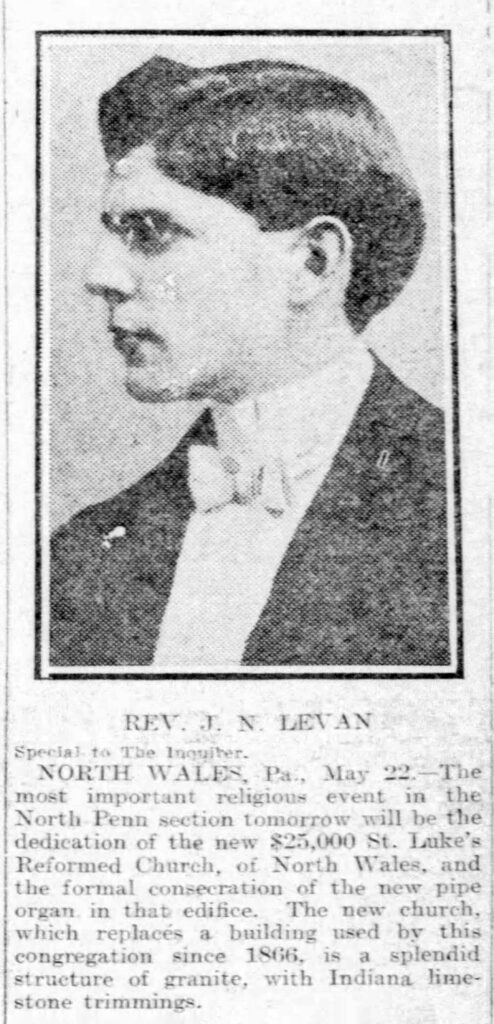
At the conclusion of Burgess Billiard’s address, Rev. J. N. LeVan, who was then pastor of St. Luke’s Reformed Church, delivered the following dedication address:
“This large gathering before me and around me proves the feeling and interest that the occasion has excited. The hundreds of human faces, glowing with sympathy and joy, and from the impulses of a common gratitude proclaim that the day, the place, and the purpose of our assembling have made a deep impression on our hearts.
“To the firemen the recollection of false and needless alarms, with hurried steps down the railroad tracks to the trolley bridge, armed with axes, buckets, helmets and other equipment, may today prove annoying, but in the thought of the larger, purpose, the finer motive of our gathering, we forget the past unpleasantness and press on to the proper celebration of .an event of import to our community.
“We are come together to set apart this building to a specific use. It is to be, henceforth, a building of and for the community. We today set it aside to its proper use, and place within it an engine of protection to the property of the community. We trust that the engine will never be called upon, though if it be called upon, may it be equal to any emergencies; and out of the chambers of this building may come legislation that shall advance, elevate and strengthen our community and the community life.
“The erection of a building for use as a town hall, and the adequate apparatus to protect the citizens’ property, I believe bespeaks a material progress in our community and is evidence of the development of a civic pride. Today we feel that something of importance has been accomplished for our town and community. The public spiritedness that you have manifested as citizens is it be commended, and I desire to avail myself of this opportunity and heartily congratulate you on the attainment of a most worthy ideal; on a step that will place North Wales in the forefront in the list of desirable suburban towns. A step in the right direction has been taken; let us not stop, but keep right on stepping.
“You live in a community, and that organization gives you certain rights. You have according to our Constitution a right to life, property, protection, happiness, and the blessings of liberty to ourselves and our posterity.
“Keep your duties ever before you, develop a civic pride, work for a beautiful North Wales. Keep your fighting edge. A good citizen must be a good citizen of his town and community first before he can with advantage be a citizen of the nation and of the world at large. I wish you well and I believe in you and in your future.”
This post is sourced from a column entitled Early North Wales: Its History and Its People penned by long-time North Wales resident historian Leon T. Lewis. The article appeared in its original form in the December 8, 1959 issue of the North Penn Reporter