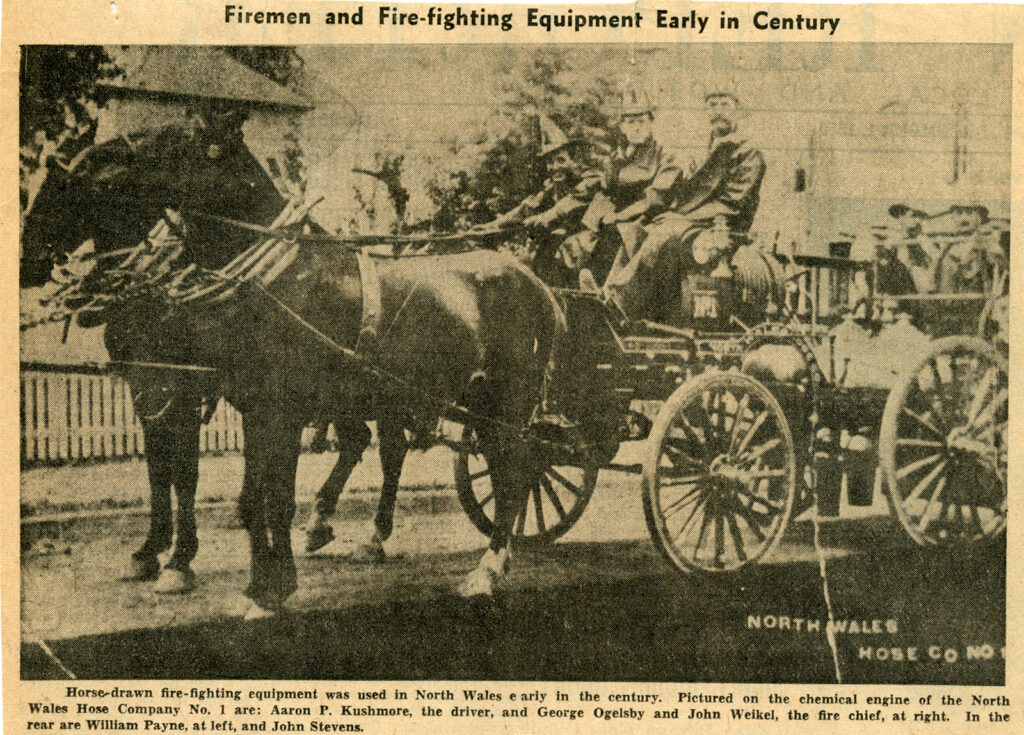
In 1910 the Borough of North Wales was growing, as was the need for better fire protection. The old hand-drawn hose carriage was outmoded. It being necessary for the men of the fire company to run from their places of employment to the fire house at the sounding of the alarm, and then running with the hose carriage to the scene of the fire, which consumed too much time. In order to keep up with progress, Borough Council, on March 7, 1910, ordered a horse-drawn chemical fire engine.
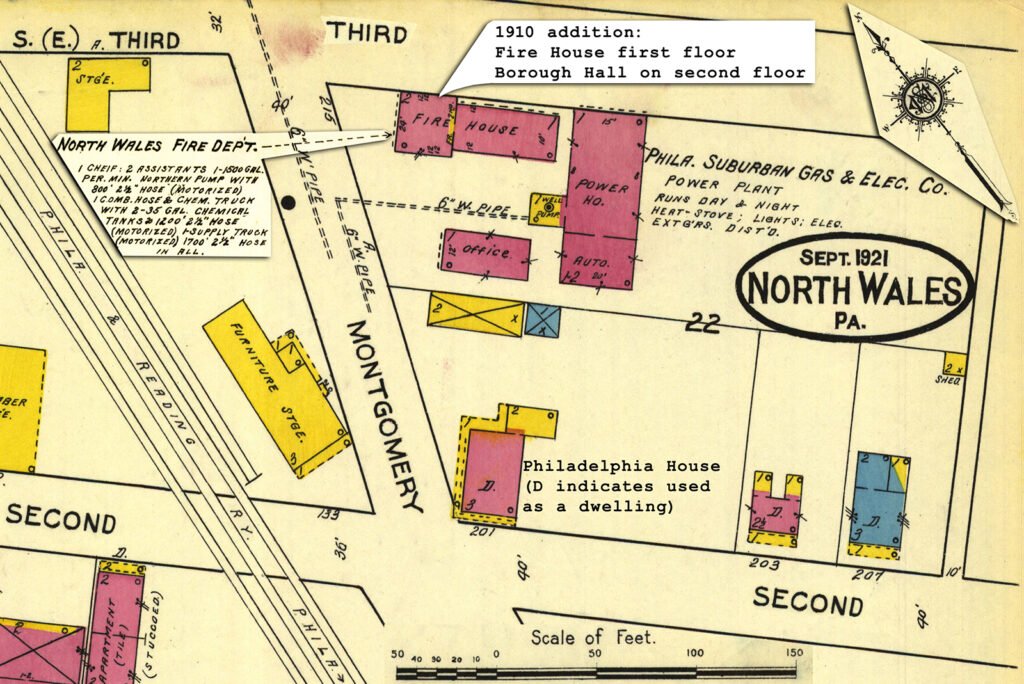
There not being sufficient room in the old hose house for the new equipment, and council not having a place of their own to hold meetings, it was decided to obtain bids for an addition to the fire house to provide room for both a fire engine and borough hall.
On April 10, 1910, Abel M. Fry of Lansdale was awarded the contract to erect this building for the sum of $2,095.49. That is $73,000 adjusted for inflation (2026).
This brick building was completed by July 11, 1910. On that day the new fire house and borough hall were dedicated with elaborate ceremonies, and the new fire engine housed after a large parade.
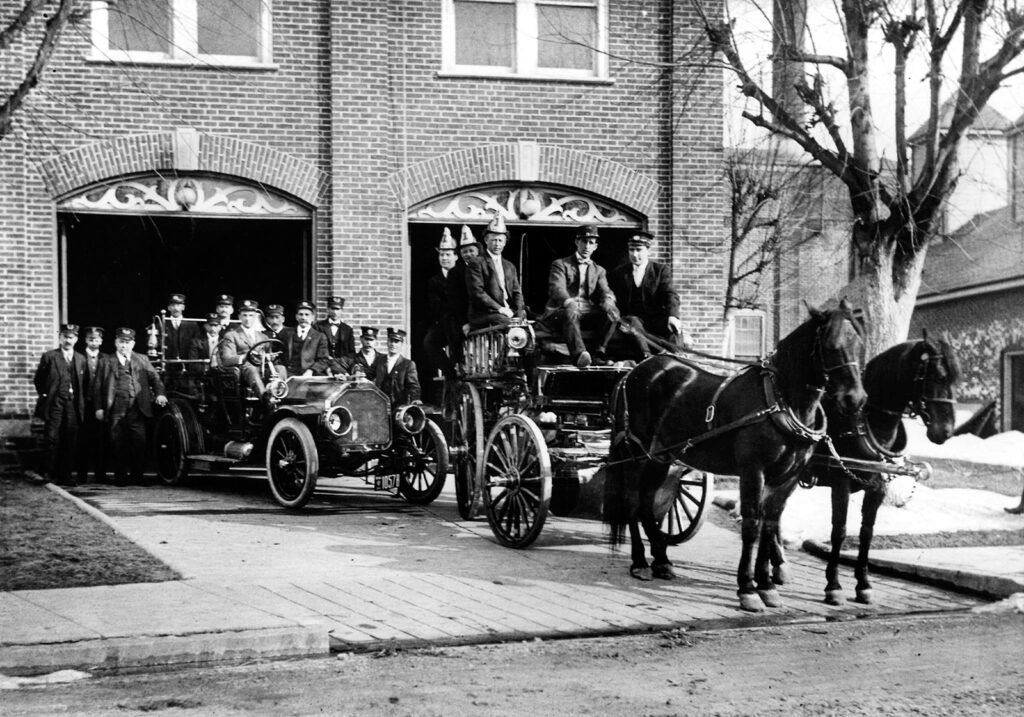
That the parade was a huge success can be gathered from the account in the local paper of the day: “With the streets lined with people all anxious to see the new chemical apparatus and the marching firemen from the adjoining towns, the firemen’s parade on Saturday was a success in every particular. The firemen began to arrive shortly before noon, when the Wissahickon engine from Ambler came up Sumneytown Pike drawn by two fine horses. The Lansdale and Souderton trucks soon followed. Shortly after 1 o’clock the West Point firemen arrived. Most of the firemen arrived on the 2 o’clock trains; the bands were also on these trains.
“The different companies assembled on Main Street in the vicinity of the railroad, where they were assigned to places in the line by Chief Marshal John Weikel. When the parade passed the hose house, the North Wales company with its apparatus fell into line, the new chemical engine bringing up in the rear. The intense heat of the summer day interfered somewhat with the number of men who intended to parade, and some of those who started were compelled to drop out of line before the parade was over on account of the heat.”
The parade was made up of the following: mounted police John Stevens and Charles Frank. Burgess James Billiard, mounted. Chief Marshal George Moss, mounted. Germania Band of Quakertown, 30 pieces. Fairmount Fire Company, Lansdale, 35 men. Fairmount Chemical apparatus, Fairmount Junior truck drawn by 12 boys, Fairmount Hook and Ladder truck. Telford Drum Corps. Telford Fire Company, 45 men. Assistant Marshal William A. Payne, mounted. Keystone Band, of Richlandtown, 30 pieces.. Quakertown Fire Company, 30 men. Souderton Drum Corps. Perseverance Fire Company, Souderton, 35 men. Perseverance Hook and Ladder truck. Assistant Marshal George Ogelsby, mounted. Wissahickon Fire Company, Ambler, 30 men. Wissahickon Chemical Engine. West Point Fire Company, 50 men. West Point Juniors. Thomas Gibson, Jr., dog and cart. West Point Hook and Ladder truck. West Point Ladies Auxiliary. Citizens Band of Quakertown, 30 pieces. North Wales Hose Company, 20 men. First Hose cart. Hose, cart No. 2. New Chemical Engine, Aaron P. Kushmore, driver. Independent Americans, and various floats.
It was a beautiful day for a parade, the big red fire engines were glistening in the sun, the firemen in their red and blue uniforms were marching proudly at the heads of their companies, the horses were prancing majestically to the music of the bands. Suddenly the deep throated voice of the steam fire alarm whistle was heard above the strains of John Philip Sousa’s “Stars and Stripes Forever.”
We quote from the local paper: “When the parade of the firemen was nearing the end on Saturday an alarm of fire was sounded. The head of the parade had just reached the fire house and many people thought the whistle was blown for that reason. A moment later, however, when the alarm was repeated, the firefighters started for the scene of the supposed conflagration. What had been an orderly parade instantly became a scene of confusion. The visiting firemen following the lead of Chief Weikel, started in search of the fire. The horses of the Ambler Chemical Company following close behind Aaron Kushmore and his dashing horses hitched to the new chemical.
The Lansdale and Souderton trucks also joined in the race, while hundreds of people gathered on the railroad in their efforts to locate the fire. The 3 o’clock train, which had been delayed at Ambler, came on the scene at this time drawn by an engine running backwards. That no one was hurt is remarkable.
It was reported that the fire was at the big greenhouses of the Florex Gardens, but inquiry there developed the fact that no one had sent in an alarm and there was no fire. Solomon Scheetz, who was on duty at the light plant, sounded the alarm when he received a message from the telephone exchange, which was repeated and to the effect that the fire was at the greenhouses.
Chief Weikel stated that he had been informed the alarm was sent in from the public telephone at the Central Hotel, but was unable to learn who sent in the alarm.
Official notice was taken of the false alarm at the meeting of Borough Council Monday evening. It was decided to offer a reward of $25 for the arrest and conviction of the parties who turned in the alarm.
This post is sourced from a column entitled Early North Wales: Its History and Its People penned by long-time North Wales resident historian Leon T. Lewis. The article appeared in its original form in the December 1, 1959 issue of the North Penn Reporter