In 1879 an unknown writer for the local paper [the North Wales Record] had this to say about North Wales:
“The Borough of North Wales, situated at the intersection of the North Pennsylvania Railroad and Sumneytown turnpike, is the most important station on the line of that railroad between Philadelphia and Lansdale. From the former place [Philadelphia] it is distant nineteen and seven-tenths miles, and lies but two miles due south of the latter. It ranks among the most pleasant, healthy and convenient places of residence of any of the villages created by the railroad. Its schools are excellent. The churches are numerous and well attended, its business facilities superior and the moral tone of its society generally high. One of the features of the latter is the freedom from form and undue conventionality, its plainness and cordiality, without the class distinction which pride and aristocracy make odious the social relations in many of our country villages.
“Its location is commanding, and its site most attractive, upon the brow of an elevation that rises from the level of the Wissahickon that flows past at a short distance to the north and the west. From the height at the southeastern extremity of the borough, a splendid prospect may be obtained extending in nearly every direction.
“Looking over the wide-spreading plains and valleys of a rich and populous agricultural landscape far to the north and west may be seen the blue line of the Lehigh hills, the south mountains of Berks and the highlands bordering the Schuylkill. To the west, the hills that form the southern boundary of the fair valley of the county are distinctly visible as well as the vast space of intervening country embracing the townships of central and southern Montgomery.
“The town shows to excellent advantage from several points along the line of the Stony Creek railroad, its spires and numerous buildings on the crest of the rising hill giving the impression at a distance of a much larger village than the reality.
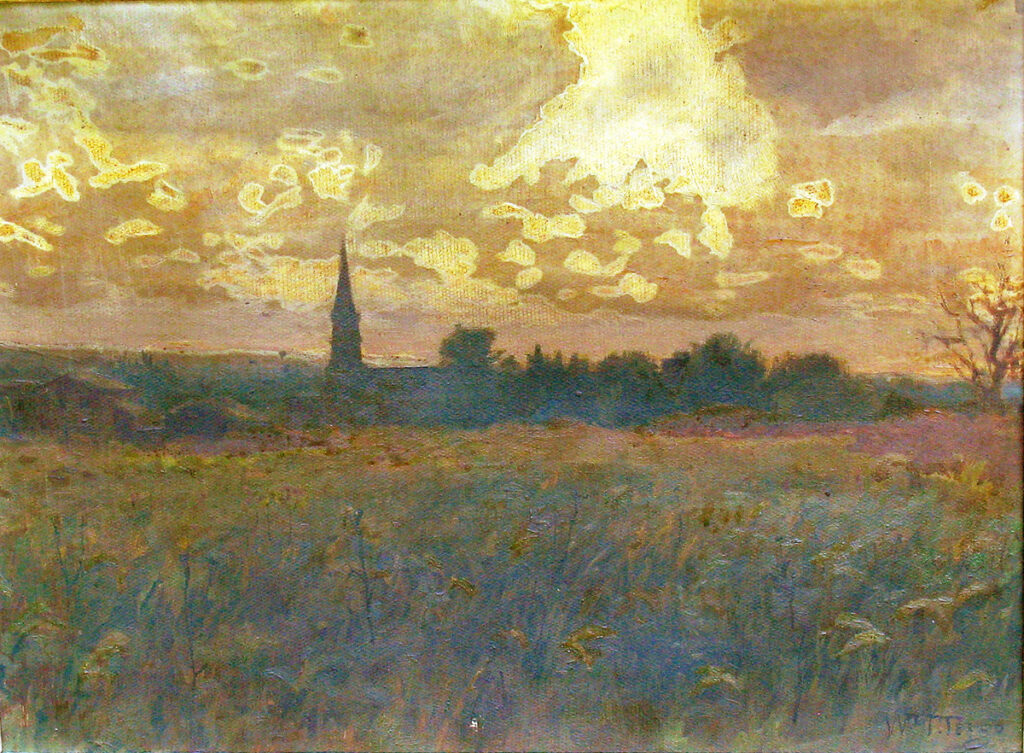
“A few miles to the northeast arises, amid the planes of western Montgomery and northern Gwynedd, the head waters of the beautiful Wissahickon. This stream, increasing in volume, passes at less than a mile distant from the village, encircling it on three sides, powering three mills within a few miles from its source. Following the waters of that stream for several miles, the Stony Creek railroad passes in a half circle to the north and westward, having three stations within a mile and a half of the borough, those of Kneedler, Lukens [West Point], and Acorn. The second of these is new but a growing and important village, whose business North Wales would have absorbed had she become the terminus of that railroad, instead of Lansdale.
“North Wales is notably well built, the dwellings, especially upon the principal streets, being of brick and stone, and large and spacious. The style is quite plain, however, in accordance with the taste and modes of the population.
“The turnpike, running from northwest to southeast, forms the principal thoroughfare known as Main street, upon which are situated the best dwellings and the principal places of business. The area of the borough lies most largely to the eastward of this, and the parallel streets are numbered in rotation from the turnpike to sixth. The cross streets are School, Walnut, Shearer, Montgomery, Church and Washington streets. The railroad running north and south bisects the borough into two nearly equal parts, although the larger portion of the population dwells on its westerly side.
“A number of dwellings which should probably be included within the borough limits are outside, within the surrounding Township of Gwynedd, on account of the restricted area of the incorporated limits.
“It is unfortunate that more taste and foresight should not have been shown in laying out the town. The streets, parallel to the turnpike, might have easily been made wider and spacious avenues, the lots larger, giving ample room for shade and shrubbery and the dwellings set back from the line of the streets giving a much more elegant and pleasant appearance as well as greatly enhancing the beauty of the village.
“The town has three hotels, the oldest of which is on the Main street, now conducted by Peter Feigel, but long kept by Abel Lukens, a veteran hotel keeper, formerly known to the farming community, when for many years in the same business in Philadelphia, as proprietor of the Lamb Hotel.
“The two others are the Philadelphia House kept by William Miller at the corner of Second Street and Montgomery avenue, and the Central Hotel, kept by James Wambold, on School street near the station.
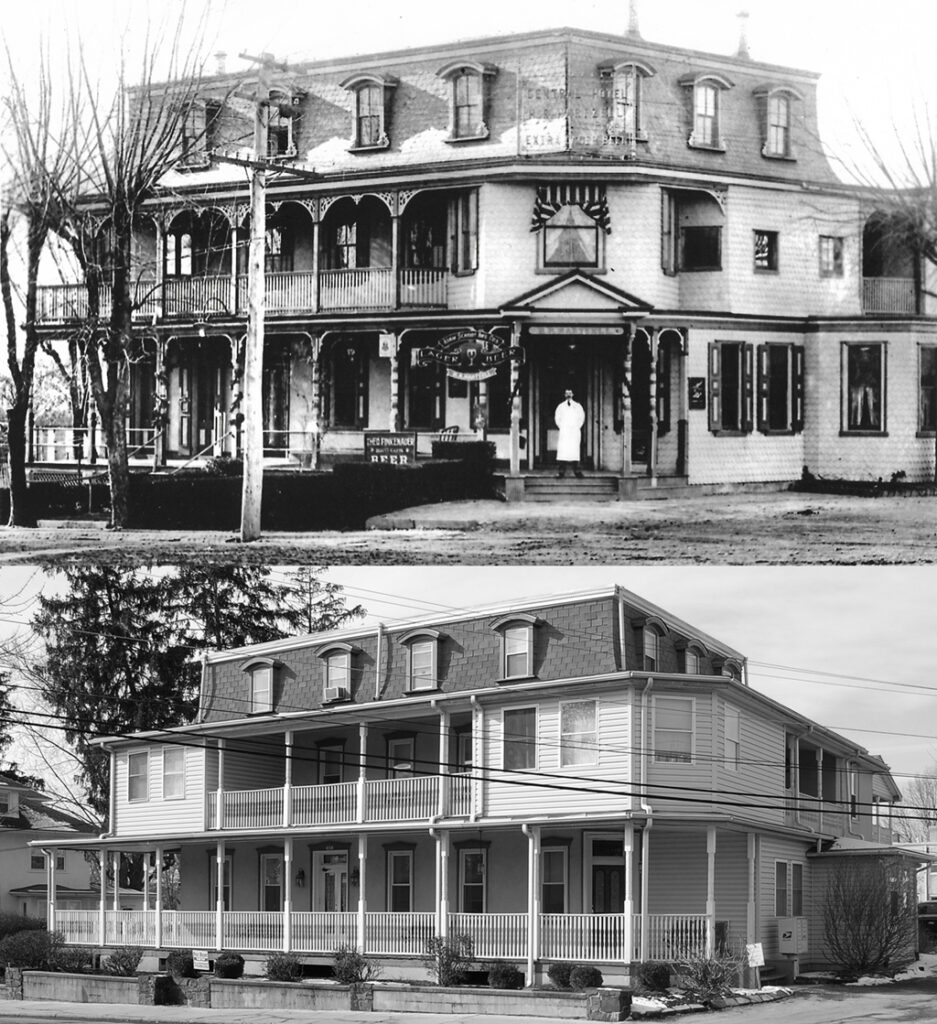
“Just opposite the Depot is the restaurant of Nathaniel Quillman run by Aaron Van Fossen. All these hotels make a specialty of entertaining city boarders during the summer season.”
We will continue with this history in subsequent posts [this being part 1 of 4].
This post is sourced from a column entitled Early North Wales: Its History and Its People penned by long-time North Wales resident historian Leon T. Lewis. The article appeared in its original form in the December 15, 1959 issue of the North Penn Reporter