The description of North Wales written in 1879 continues as follows:
“Of the mercantile establishments there are but two general stores, that of Harley & Brother on Main street, which has done an extensive business for many years past, and the newly opened store of Augustus W. Dettra, succeeding that, known as Kuhn’s lately kept by James R. McDowell, now of South Chester.
“On Main street near the railroad crossing is the office of the North Wales Record which is doing a large business in the printing line and which is a journal that has obtained a wide circulation and extensive influence throughout the central portions of Montgomery and the adjacent sections of Bucks county. Its increase in these respects has been especially noticeable within the past two years, since the present owner, Wilmer H. Johnson, has taken charge of its columns. Its local columns are especially full and interesting and its historical sketches during the past year have been a feature in which it has exceeded all its contemporaries. Its management generally has caused it to rank among the better country journals of the state, something remarkable for a paper published away from any county seat, and in a comparatively small village.
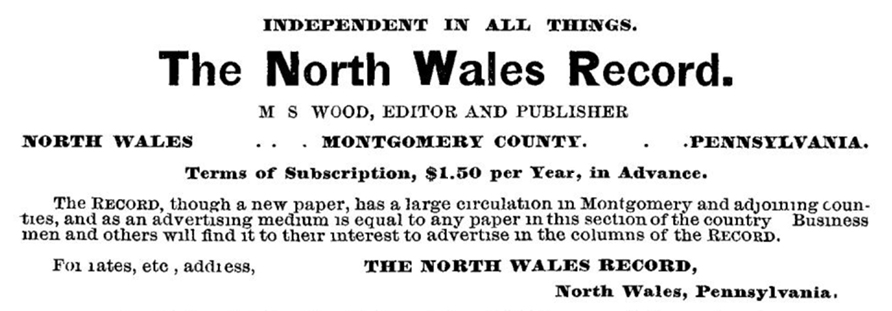
“Closely adjoining the Record office and in the same building is the hardware and tin store of Jacob H. Leister, of many years a stand for that business.
“Next we come to the extensive steam, feed and flouring fill of E. K. Freed & Company who do a large business by hauling grain offered from neighboring farmers and also largely from the western states. The mill is propelled by a steam engine of 50 horse power. A coal yard and hay scales are attached.
“On the same street may be noticed the harness shop of E. M. Keller, and shoemaking is carried on by Peter Bean and A. S. Klausfeldter. A knight of the tonsorial art plies shears and razor in the person of William H. Staiger.
“The staff of life is furnished at Ernest Winters’ bakery, not only for the town but for a large circuit of adjacent country.
“For its size, the town is unusually well supplied with drug stores. One being kept by Dr. Benjamin K. Johnson, the other by Dr. John Sibald; and at the store of the latter is the Post Office. Both of these gentlemen are practicing physicians.
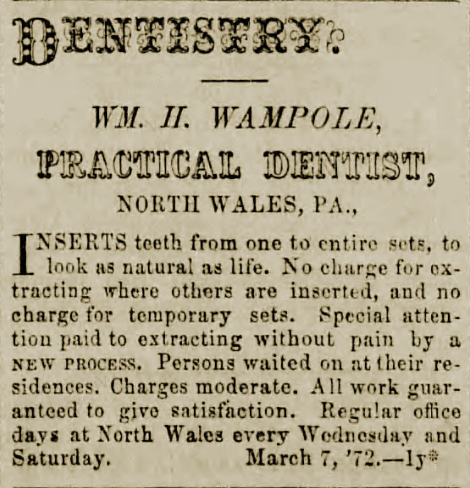
“A professional dentist in the person of Dr. William H. Wampole occupies the north corner of Second and Walnut streets. On the opposite side of Main street is the watch and jewelry store of David H. Krauss.
“The town affords two millinery stores, both on Main street, one kept by Mrs. Elizabeth B. Ayles and the other by Mrs. Charles H. Meredith.
“The remaining mercantile establishments and shops in other portions of the town are two cigar stores and manufactories kept by John Weingartner and Capt. Aaron W. Snyder; the lumber yard and hay press owned by Abel K. Shearer; the planing mill owned by Shearer and Lukens; the large feed house and coal yard of Swartley Brothers near the railroad.
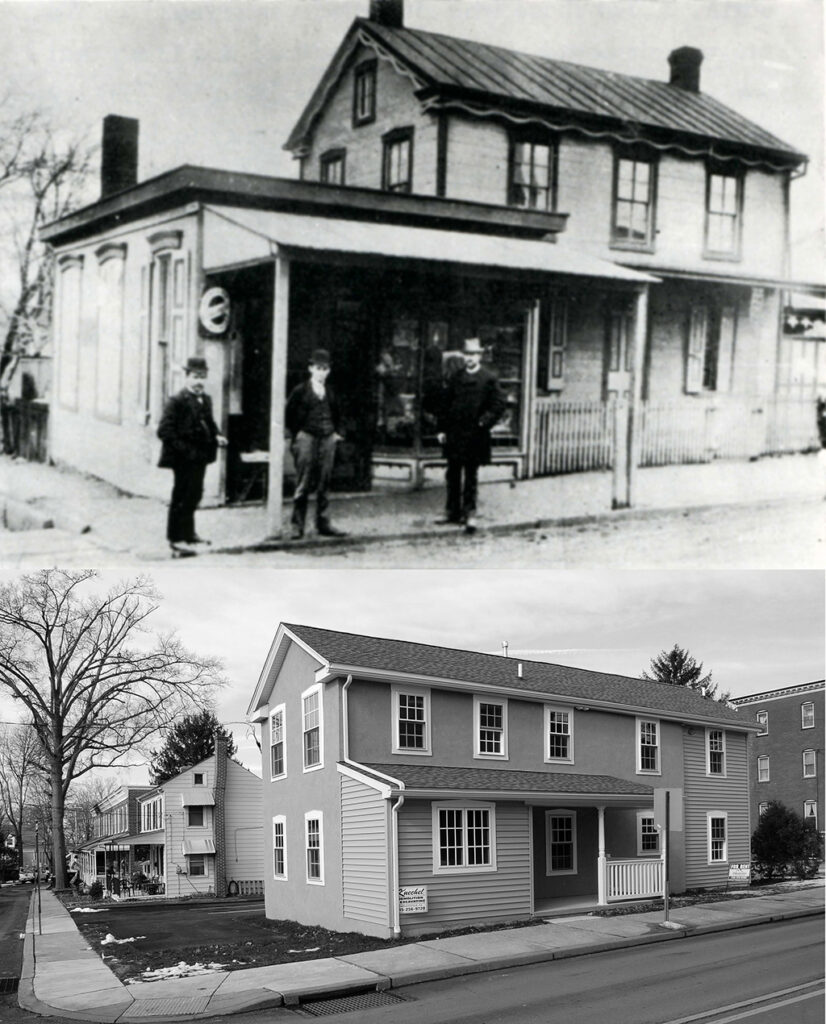
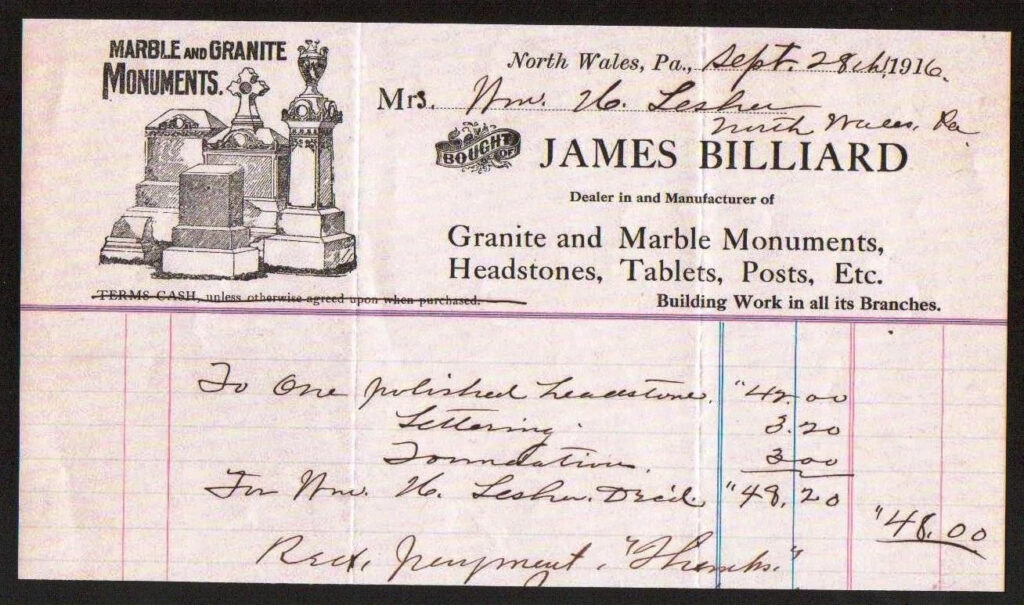
“Other industries of the borough are Billiard’s marble yard, the greenhouse of John Gerhart, the tailoring shop of John Haas and Joseph McCracken, Peter Lalley’s blacksmith shop and Daniel A. Fisthyler’s and Sylvester Bright’s carriage works. The former is a new beginner, while the latter has been established here for several years. The mechanical reputation of both are first class.
“Billiard’s marble works, opposite the Record office, is one of the substantial institutions of the town, though opened but a little more than a year ago. Most of the marble used here comes from Philadelphia and Norristown. It is bought by the cubic foot when in large pieces and by the superficial foot when in slabs. Mr. Billiard’s principal business is in tombstones, mantels and house furnishings, such as window sills and door steps. Before coming to North Wales, Billiard was in the business at Hellertown.
“The sash factory and planing mill of Shearer and Lukens is not behind in the advancement of the present age; and in fact they have to be well up in improvements to compete with the several other manufactories near North Wales in turning out first class work, which is the essential element of success in this as well as other business. They are able to turn out as fine work as can be done anywhere, manufacturing window and door frames, sash, moulding of all descriptions, doors and almost all kinds of woodworking. They also turn out an excellent class of office furniture.
“The village is amply supplied with churches, there being no less than four in number, two of which are graced with lofty spires. Quite a variety of religious beliefs are represented in the population, including a few Friends [Quakers]. The two oldest churches are those of the Lutheran and German Reformed, successors to the old Yellow Church which embraced both denominations. The Reformed church is substantial stone structure, erected in 1866. The Lutheran [St. Peter’s] is also of stone, built in 1868 at a cost of $9000. It stands on a commanding site and its spire is a conspicuous landmark to be seen for a great distance.
We will have more of this 1879 history in our next installment.
This post is sourced from a column entitled Early North Wales: Its History and Its People penned by long-time North Wales resident historian Leon T. Lewis. The article appeared in its original form in the December 22, 1959 issue of the North Penn Reporter