The history of 1879 continues: “The newer churches are those of the Baptist and the Methodist, in opposite portions of the town. Both are plain stone structures; the latter is yet unfinished, although begun in 1871.
“The Gwynedd Baptist church, a mile to the northward, was built in 1862, but its situation proving inconvenient for the village congregation, a new one was built in the borough in 1874. Of course, these churches form a worshiping point for a large section of the adjacent country as well as the village.
“But a mile distant at Gwynedd village, is the Episcopal church of that name, and the ancient Friends Meeting House. The influence of a strong religious element in forming and molding the moral tone of the population is plainly perceptible, largely the result of the training of the past generations.
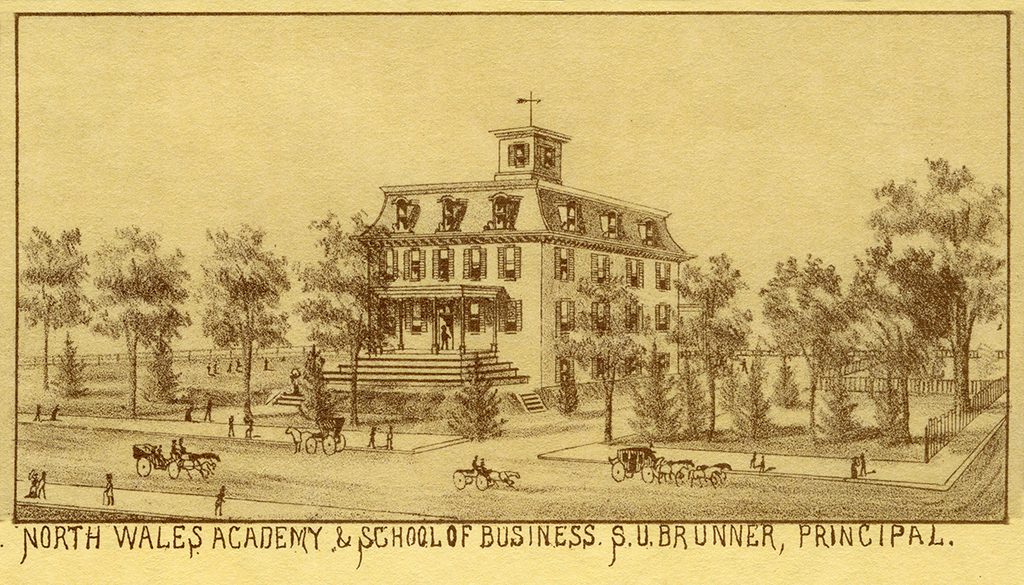
The educational interests of North Wales are represented by the private school situated in the southern part of the town and for several years past conducted by Professor Samuel U. Brunner. Its predecessor, the North Wales Institute, was commenced in the village about 1860, by Mahlon S. Myers, assisted by Abraham S. Oberholtz, in the house on Main street now occupied by Dr. Benjamin K. Johnson and Ernest Winters, (now [1959] the Kratz Real Estate office). This continued for a few years during the [Civil] war, after which, there was no higher institution of learning. Samuel U. Brunner, who had previously taught a similar school in Kulpsville, first opened the North Wales Academy in the house now owned and occupied by Johnathon Scott (now the home of Dr. E. W. Olson) on the 10th of April 1871, where it continued for two years. In the spring of 1873, it was removed to the present large stone building, a prominent object that can be seen from passing railroad trains. [Brunner’s Academy was located on Pennsylvania Avenue between Montgomery Avenue and the site now occupied by the North Wales Area Library.] Principal Brunner gives special attention to the requirements of a business education. The attendance of pupils has risen as high as 35 during some sessions.
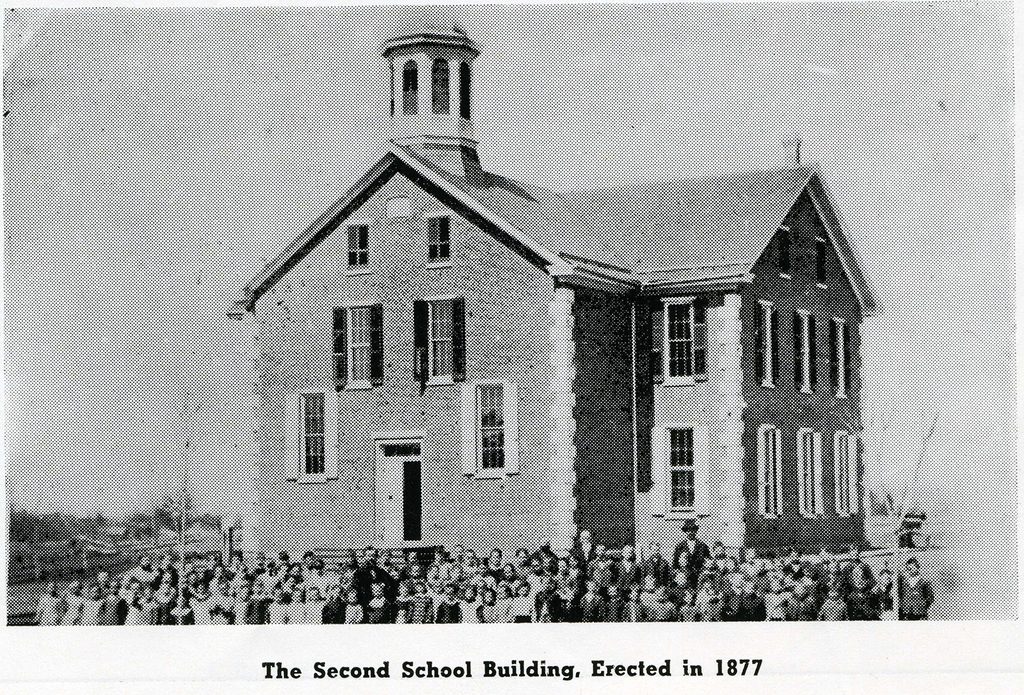
“Up to 1877 the public schools were taught in a small structure on Main Street [opposite School Street], formerly belonging to Gwynedd Township. This proved insufficient for the requirements of the borough, so a large brick structure was erected in 1877 on School Street between 3rd and 4th Streets, costing $7000.00. It is one of the best possessed by any village in Montgomery County and is a credit to the town. Pupils are graded in three departments, the principal of which is Enos H. Rosenberger, assisted by Miss Emma Mauger and Miss Lizzie Magee.
“Judging from the names found in the list of taxables, about two-thirds of the inhabitants of North Wales may be estimated of German or Hollander descent, the remaining one-third are of British origin. This is about the proportion found in the immediate surrounding countryside. The German language was, until twenty or thirty years ago, largely spoken by those of that race living in the vicinity, but has now almost wholly been superseded by the English. However, but a few miles northwest, German yet remains in common use.
“The growth of the town during the decade between 1860 and 1870 was quite rapid and for many years surpassed Lansdale in both trade and population. It was not until the completion of the Stony Creek railroad that Lansdale obtained superiority.
“During this period the constantly increasing growth of so large and prosperous a village began to call the attention of its most intelligent and progressive citizens to the necessity of obtaining a borough charter in order to have better schools, paved sidewalks, lighted streets, etc., things necessary to every town after emerging beyond a certain size. As usual, this was vigorously opposed by the more conservative citizens, and those fearing increased taxation. North Wales Borough was finally incorporated in 1869.
“By the census of 1870, the population was found to be 407, which has increased at the present time [1879] to 625. The number of those eligible to vote is 137. Recently the growth of the town has almost ceased; nor is it likely to take another start until more prosperous times will justify men of enterprise to project new industries as a means of employment for a greater number of people. The borough’s growth otherwise must only result from the gradual increase caused by the coming thither to reside those people attracted by its conveniences and its advantages as a place of residence.
“We will next give a brief historical notice of some of the older and more prominent business establishments of the town. That way, the men who established the businesses, and the early ownership changes, will not be among the forgotten things of the past.”
We will continue with part 4 of 4 of the 1879 history in the next installment.
This post is sourced from a column entitled Early North Wales: Its History and Its People penned by long-time North Wales resident historian Leon T. Lewis. The article appeared in its original form in the December 29, 1959 issue of the North Penn Reporter